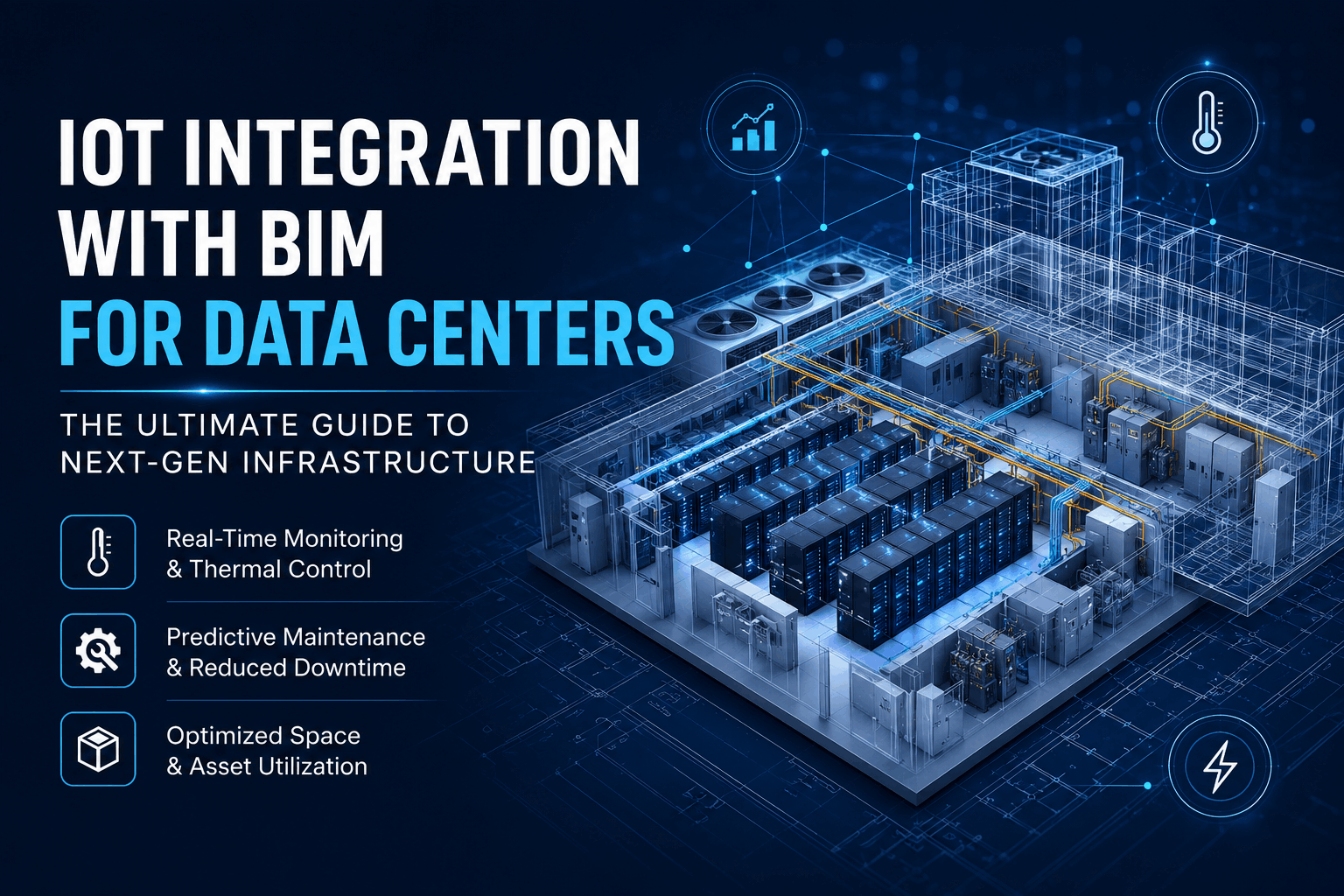
The rapid expansion of cloud computing, artificial intelligence, and edge networks has turned modern mission-critical facilities into complex ecosystems. Today, IoT Integration with BIM for Data Centers stands at the absolute forefront of engineering innovation, bridging static design data with real-time operational metrics. When facility managers combine Building Information Modeling with physical sensor networks, they unlock unprecedented control over thermal efficiency, energy distribution, and proactive equipment maintenance.
Navigating the complexities of high-density server environments requires more than conventional spreadsheets or disconnected blueprints. Implementing BIM IoT Integration ensures that physical infrastructure communicates dynamically with its digital counterpart, creating a single source of truth for engineering and operational teams.
Understanding the Synergy of BIM and Smart Infrastructure
To appreciate why IoT Integration with BIM for Data Centers is transforming the architecture, engineering, and construction (AEC) sectors, we must first examine the individual components. Building Information Modeling establishes a multi-dimensional digital prototype embedded with rich asset metadata, structural parameters, and precise geometric profiles. Meanwhile, Smart Infrastructure relies on thousands of Internet of Things (IoT) sensors to continuously stream live data regarding temperature, humidity, power draw, and mechanical stress.
When these two powerful paradigms merge, the static 3D model evolves into an interactive digital twin. Instead of waiting for a component failure, operators can visualize live environmental telemetry directly inside the spatial layout of the facility. This convergence minimizes human error, optimizes Power Usage Effectiveness (PUE), and guarantees high availability across mission-critical server halls.
Core Architectural Benefits of BIM IoT Integration
Adopting a connected digital framework yields immediate dividends across the entire asset lifecycle, from initial design validation down to daily facility management operations.
1. Real-Time Thermal Management and CFD Analysis
High-performance computing clusters generate intense heat profiles that can easily compromise uptime if left unchecked. By feeding real-time thermal sensor feeds into a coordinated model, Computational Fluid Dynamics (CFD) applications can map localized hot spots instantly. Engineers can evaluate cold aisle containment performance without disrupting live workloads.
2. Predictive Maintenance and Reduced Downtime
Traditional reactive maintenance models often result in costly service interruptions. Through continuous telemetry streaming, predictive algorithms analyze wear-and-tear metrics on Uninterruptible Power Supplies (UPS), cooling towers, and computer room air handlers (CRAH). Maintenance teams receive automated alerts pinpointing the exact physical coordinates of a failing component inside the BIM interface.
3. Optimized Space and Asset Capacity Planning
Data center white space is an expensive commodity. A live model integrated with asset-tracking sensors provides instant visibility into floor weight limits, rack availability, and clearance zones. This level of precision eliminates guesswork during hardware upgrades or client expansions.
Overcoming Engineering Challenges in Mission-Critical Facilities
Implementing a unified data ecosystem involves bridging historical silos between IT hardware administrators and operational technology (OT) facility teams. Without a structured workflow, vast streams of sensor data can quickly overwhelm legacy management systems.
This is where multi-disciplinary coordination becomes vital. Utilizing advanced platforms such as Autodesk Revit, Navisworks, and cloud environments ensures that every cable tray, busway, and sensor node is mapped accurately before physical installation. Furthermore, establishing a rigorous BIM Execution Plan (BEP) ensures compliance with international standards like ISO 19650, streamlining cross-continental engineering collaboration.
To explore more about foundational modeling practices, review this comprehensive guide on BIM for Data Centers. For deeper insights into spatial coordination, reference industry standards detailed by the National Institute of Building Sciences (NIBS).
Leveraging Advanced Digital Twins and Coordination Services
As facilities grow larger and denser, manual tracking is no longer viable. Modern engineering teams rely heavily on specialized Digital Twin Technology for Data Centers to maintain total situational awareness. By mapping real-time operational telemetry onto accurate Level of Development (LOD) 400 models, stakeholders can simulate emergency shutdown procedures and electrical load shifts safely in a virtual environment.
Additionally, integrating high-definition 3D laser scanning—commonly known as Scan to BIM—allows operators to capture exact as-built conditions of legacy structures. This ensures that retrofits and expansions align seamlessly with existing MEP (Mechanical, Electrical, and Plumbing) layouts, preventing costly clashes on the construction floor. For further reading on infrastructure resilience and IoT standards, you can explore insights from IEEE.
Accelerate Your Infrastructure Performance with Acura BIM
Building, expanding, or retrofitting a mission-critical facility demands absolute precision, rigorous quality control, and deep domain expertise. At Acura BIM, we specialize in delivering comprehensive engineering, multi-disciplinary coordination, and advanced modeling solutions tailored explicitly for hyperscale, enterprise, and colocation data center developers.
Our expert engineering teams leverage industry-standard platforms—including Autodesk Revit, Navisworks, and the Autodesk Construction Cloud—to build friction-free, fabrication-ready models that lay the ideal foundation for your operational digital twin. Whether you require detailed BIM Coordination Services, clash detection sweeps, or precise as-built modeling, we help you eliminate design ambiguity and accelerate speed-to-market.
Frequently Asked Questions (Q&A)
Q1: What is the primary role of BIM in modern data center management?
Building Information Modeling provides a centralized, data-rich 3D digital prototype of the entire facility. It acts as the spatial framework that houses critical asset metadata, enabling seamless coordination during construction and serving as the foundation for live operational monitoring.
Q2: How do IoT sensors enhance a data center digital twin?
IoT sensors stream continuous real-time data regarding temperature, humidity, electrical load, and equipment vibration directly into the virtual model. This empowers operators to track thermal performance, predict hardware failures before they occur, and automate maintenance workflows.
Q3: Why is LOD 400 important for data center modeling?
Level of Development (LOD) 400 incorporates precise fabrication, assembly, and installation details into every structural, mechanical, and electrical component. This granularity ensures that pre-fabricated modular components fit together perfectly on-site, significantly cutting down construction schedules and eliminating field errors.
Q4: How does Acura BIM support data center development projects?
Acura BIM delivers end-to-end multi-disciplinary modeling, clash detection, MEP coordination, and Scan to BIM services designed to optimize uptime, streamline off-site fabrication, and safeguard long-term facility efficiency.