
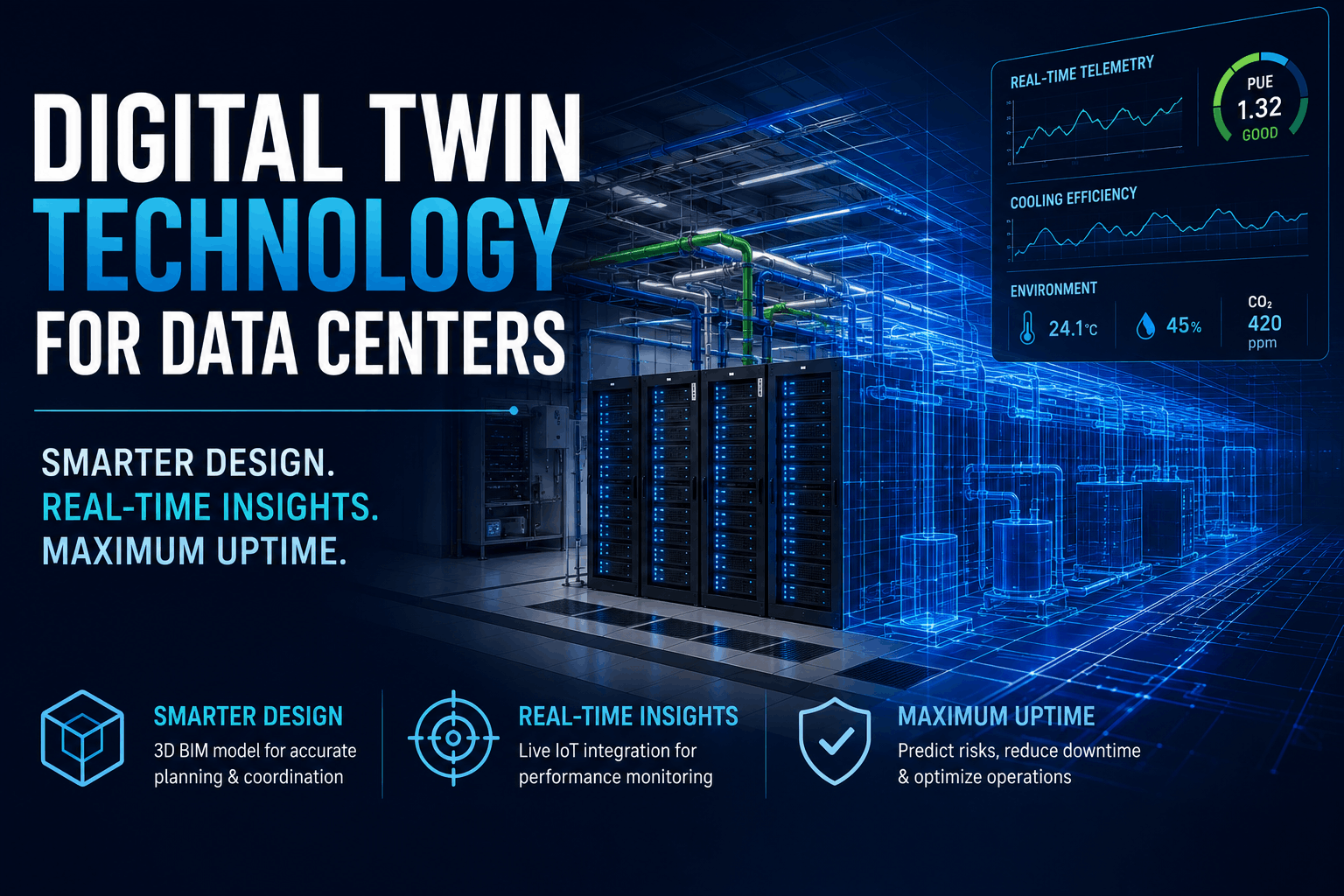
The global demand for high-performance computing, cloud ecosystems, and intensive artificial intelligence (AI) workloads has fundamentally changed the blueprint of industrial infrastructure. Today, facility owners and mission-critical operators cannot afford unexpected operational shutdowns, spatial planning bottlenecks, or inefficient cooling configurations. Building and managing these complex assets require tools that extend far beyond static 2D blueprints or standalone software tools. To achieve absolute uptime, global enterprises are transitioning to a comprehensive framework powered by Digital Twin Technology for Data Centers.
A digital twin is not merely an isolated 3D drawing or a visual model of an industrial facility. It represents a dynamic, data-rich virtual replica that mirrors a physical building in real time. By fusing highly granular engineering layouts with continuous telemetry streams, this advanced system alters how critical facilities are engineered, tested, commissioned, and optimized throughout their operational lifecycle.
What is Digital Twin Technology for Data Centers?
At its architectural core, Digital Twin Technology for Data Centers bridges the gap between virtual planning and physical deployment. The foundation of this system begins during the design phase with advanced Building Information Modeling (BIM) services. Engineers construct a multi-dimensional digital prototype that holds geometric parameters alongside dense asset metadata, including precise equipment specs, structural dimensions, and custom clearances.
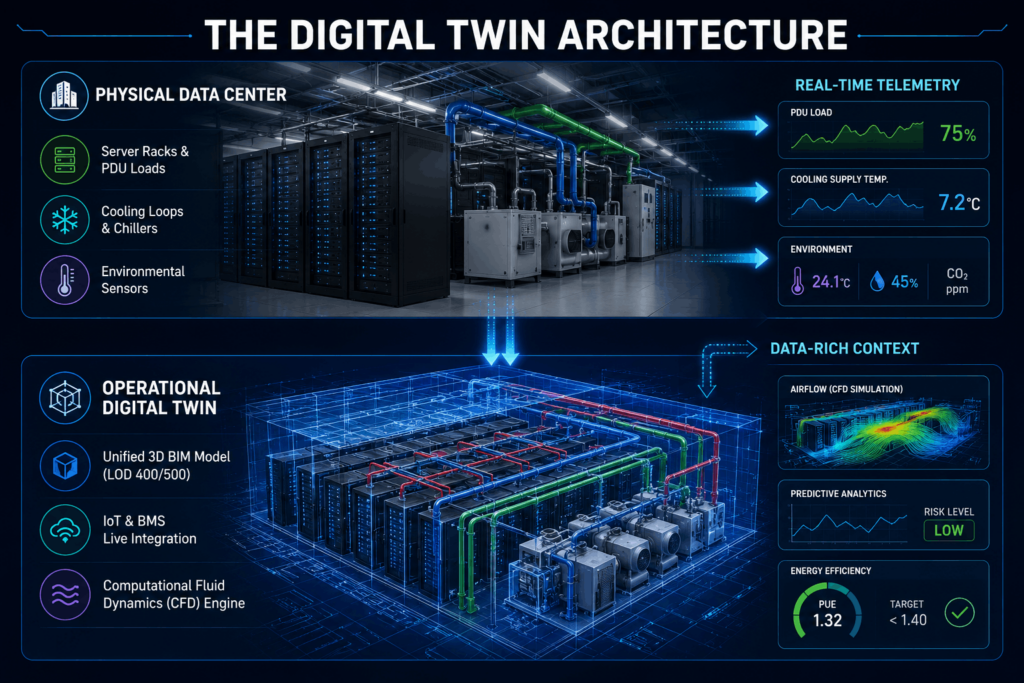
When the physical facility is built, this data-rich as-built archive connects directly to real-world Internet of Things (IoT) sensors, building management systems (BMS), and power distribution networks. The static blueprint transforms into a live, interactive ecosystem. It receives continuous data updates, providing engineers with a single source of truth to track thermal gradients, monitor electrical distribution, and execute predictive maintenance protocols with total certainty.
Why Mission-Critical Infrastructure Demands a Digital Twin Framework
Modern data infrastructure demands unprecedented availability and rapid, highly precise scalability. Traditional, fragmented documentation workflows struggle to support these high-density micro-environments, often introducing hidden errors that only surface after deployment. Implementing an integrated digital twin framework directly resolves these core structural challenges.
1. Navigating High-Density Thermal Containment
High-performance graphics processing units (GPUs) and enterprise server arrays generate intense thermal profiles. To prevent localized hot spots and control cooling costs, facility teams utilize the digital twin to simulate precise structural layouts for hot and cold aisle containment structures. By connecting the 3D layout to Computational Fluid Dynamics (CFD) applications, operators can visualize airflow velocities, predict ambient temperature changes, and verify how high-density liquid cooling loops behave under maximum structural loads before installing equipment in the physical data hall.
2. Precise Space and Asset Capacity Planning
Every square foot inside a colocation or enterprise facility represents capital expenditure. When engineering teams rely on static, flat drawings, planning equipment upgrades or installing dense cable tray pathways can easily result in geometric conflicts. A live digital twin provides real-time visibility into spatial availability and weight-bearing parameters. Designers can instantly check structural capacities, coordinate intricate mechanical/electrical/plumbing (MEP) layouts, and calculate localized floor space limits without disturbing ongoing facility operations.
3. Mitigating Risks Through Automated Clash Detection
The dense configuration of modern data ecosystems means that primary electrical busways, high-capacity cooling pipelines, and clean-agent fire suppression routing constantly vie for the exact same physical coordinates. Through automated clash detection, advanced engineering models automatically identify spatial overlaps during the design phase—such as an overhead structural beam clipping a heavy-duty cooling duct. Resolving these structural conflicts virtually avoids expensive rework on-site, prevents construction delays, and protects your project timeline.
Driving Unmatched Efficiency: Smart Facility Management and Live Digital Twins
The financial and operational value of an integrated model expands dramatically during the long-term lifecycle of the building. A primary component of this operational success rests on Smart Facility Management. When a facility moves out of construction, the field-verified model serves as an interactive data repository for everyday operations.
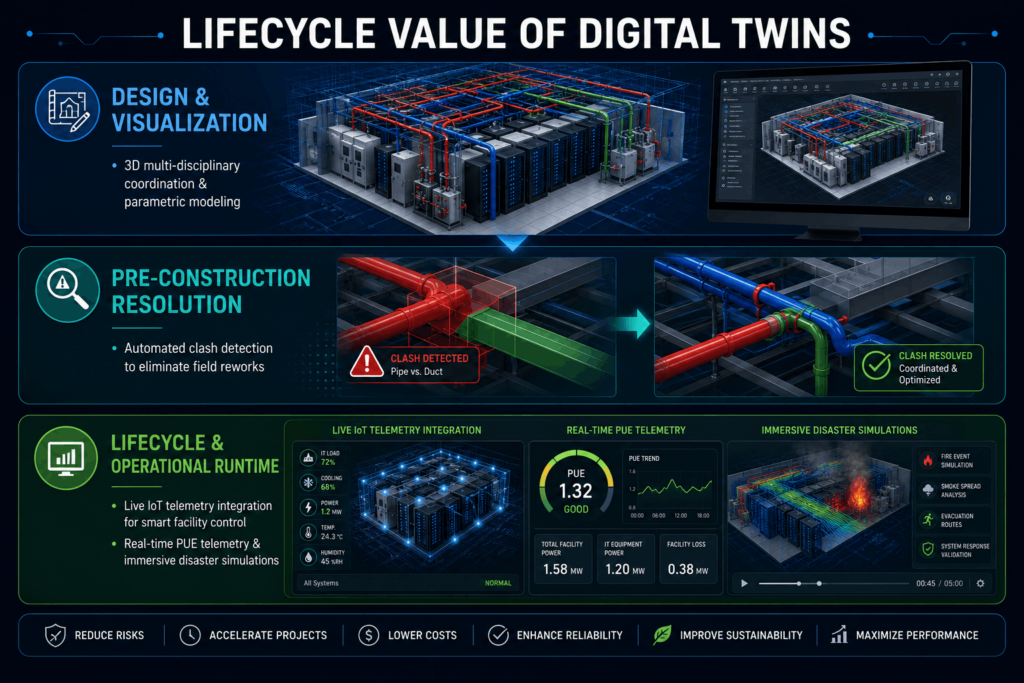
Instead of sorting through thousands of legacy 2D pages or isolated asset databases, engineering teams leverage the unified 3D interface to manage real-time infrastructure. Operators can instantly locate components, pull up historical asset records, and access equipment manuals with a single click.
Live Power Usage Effectiveness (PUE) Tracking
Power Usage Effectiveness (PUE) is the standard metric for assessing data center energy performance. A live digital twin integrates directly with electrical power monitoring platforms and power distribution units (PDUs) to track energy efficiency levels across individual server rows. If a specific cluster shows an elevated energy signature or an unbalanced electrical profile, the system alerts technicians immediately. This real-time visibility allows operators to adjust mechanical cooling outputs dynamically, preventing energy waste and optimizing overall operational efficiency.
Proactive Predictive Maintenance Protocols
Unscheduled downtime can result in severe financial penalties and service disruptions. Smart Facility Management platforms backed by digital twins utilize continuous sensor information to perform predictive asset analysis. For example, if a primary condenser pump shows abnormal vibration patterns or operating temperatures, the digital twin highlights the exact asset inside the virtual space. Technicians can review its maintenance history, verify parts availability, and resolve the issue before a component failure impacts facility runtime.
Immersive Disaster Simulations
Emergency response cohorts utilize the digital twin environment to execute virtual failure scenarios, such as localized power losses or cooling line breaks. Because the parametric model accurately links every bypass switch, redundant pipeline, and containment valve, operators can test rapid isolation protocols safely in the virtual world. This specialized training sharpens response times and ensures that backup systems perform flawlessly if an unexpected incident occurs.
Step-by-Step Implementation of a Data Center Digital Twin
Transitioning to a highly functional digital twin environment requires an organized, multi-phase digital engineering process. The workflow centers on driving data accuracy, collaboration, and seamless platform integration.
Phase 1: High-Fidelity BIM and Level of Development (LOD) Alignment
Every reliable digital twin begins with precise structural and MEP design modeling. Projects align with rigid Level of Development standards—moving from basic concepts up to fabrication-ready LOD 400 and as-built LOD 500 models. During this phase, critical spatial attributes, vendor asset details, electrical loads, and mechanical clearances are fully embedded into the virtual components.
Phase 2: Laser Scanning and Reality Capture for Existing Facilities
For legacy modernization projects or capacity expansions, engineering cohorts utilize high-density 3D laser scanning. This reality-capture workflow generates an exact, millimeter-accurate digital point cloud of the existing facility layout. Technicians convert this data into a structured model, eliminating design assumptions and ensuring new mechanical cooling infrastructure integrates cleanly without disturbing active server operations.
Phase 3: Interoperable Integration with Operational Systems
The final stage links the physical building’s operational network with the coordinated 3D structural model. Through open communication protocols and secure data exchange layers, the model connects directly with BMS, SCADA, and IoT tracking platforms. This integration ensures that whenever a sensor registers an environmental change in the real world, the data populates instantly within the digital twin console.
Unlocking Long-Term Lifecycle and Sustainable Value
Implementing Digital Twin Technology for Data Centers is an investment that yields measurable financial and environmental returns across the entire lifespan of the asset. Beyond protecting daily uptime, it directly aligns with modern enterprise sustainability targets.
- Reduced Material Waste: Precise virtual coordination and accurate material take-offs (MTOs) prevent procurement guesswork, minimizing excess material scraps and lowering overall construction costs.
- Streamlined Off-Site Fabrication: Fabrication-ready models allow complex MEP assemblies and modular containment skids to be pre-manufactured under controlled factory conditions. Components arrive on site for efficient “plug-and-play” installation, shortening construction schedules.
- Lowered Carbon Footprint: Continuous thermal optimization directly decreases energy consumption. By lowering power usage across massive mechanical cooling systems, operators can reduce their overall carbon footprint and satisfy strict regional environmental regulations.
Elevate Your Infrastructure Strategy with Acura BIM
Building, expanding, or operating a mission-critical data center demands specialized engineering experience, total accuracy, and state-of-the-art virtual design workflows. At Acura BIM, we specialize in providing advanced engineering and multi-disciplinary coordination services specifically tailored for hyperscale, enterprise, and colocation data center developments.
Our engineering teams utilize cutting-edge technology platforms—including Autodesk Revit, Navisworks, and the Autodesk Construction Cloud (ACC)—to build high-fidelity, fabrication-ready models that form the foundation of your operational digital twin. From detailed Data Center BIM Services and automated clash detection sweeps to comprehensive Scan to BIM Solutions, we eliminate design uncertainty, accelerate speed-to-market, and secure your long-term facility uptime.
Partner with an industry leader to turn your design documentation into an intelligent, sustainable asset. Explore our comprehensive suite of BIM Engineering and Coordination Services and let us help you optimize your next mission-critical infrastructure project from initial concept through to successful lifecycle handover.
Frequently Asked Questions regarding Digital Twins & Data Centers
Q1: How does a digital twin differ from a standard 3D BIM model?
A standard 3D BIM model serves primarily as a static representation of a facility’s geometry and component metadata during design and construction. A digital twin transforms that base model by connecting it directly to real-time IoT sensors, BMS networks, and live operational telemetry streams. This connection allows the virtual replica to evolve alongside the physical building, reflecting real-world performance continuously.
Q2: Can digital twin workflows be applied to existing or legacy data center facilities?
Yes. By using advanced 3D laser scanning and reality-capture technologies, engineering teams can capture an accurate digital point cloud of an active legacy facility. This point cloud data is then converted into a structured, data-rich model that can be linked to current facility monitors, creating a functional digital twin without interrupting active server workloads.
Q3: How does implementing a digital twin help optimize Power Usage Effectiveness (PUE)?
A digital twin provides continuous visibility into thermal patterns and power distribution throughout the facility. By running real-time CFD simulations and matching them with actual sensor information, facility managers can isolate hot spots, address airflow inefficiencies, and dynamically adjust chiller or containment cooling thresholds. This accurate management minimizes excessive cooling energy draw and directly improves PUE.
Q4: What are the primary software applications utilized to develop data center twins?
Building a high-performance digital twin relies on an integrated software environment. The geometric foundations and asset metadata are built using modeling applications such as Autodesk Revit. Multi-disciplinary collision analysis and coordination are managed within Autodesk Navisworks. The completed model is then integrated with specialized operational platforms, cloud environments like the Autodesk Construction Cloud, and enterprise IWMS/BMS systems to establish live data synchronization.