
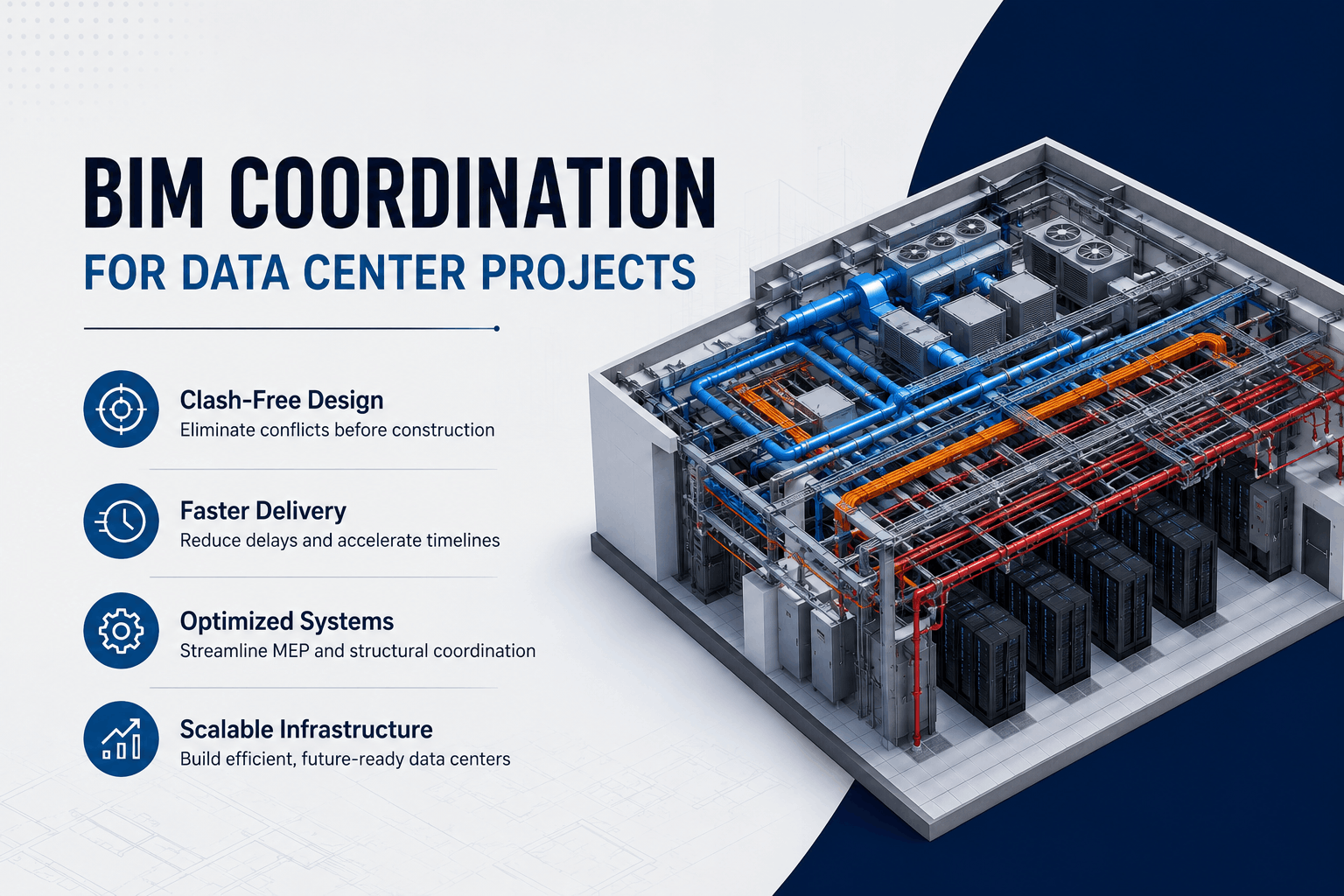
The global demand for data storage, cloud computing, and real-time processing has triggered an unprecedented surge in data center construction. However, these facilities are among the most structurally complex and systems-dense environments in the modern architectural, engineering, and construction (AEC) industry. Building a facility that houses thousands of high-density servers requires perfect harmony between structural elements, architectural layouts, and massive mechanical, electrical, and plumbing (MEP) systems. This is exactly where advanced BIM Coordination becomes the backbone of project success.
Implementing precise BIM Coordination for Data Center Projects is no longer an optional luxury; it is a critical necessity. Without a centralized, highly detailed 3D environment to resolve conflicts before ground is broken, projects frequently face massive budget overruns, severe scheduling delays, and structural inefficiencies.
As a premier BIM Outsourcing Company, Acura BIM specializes in transforming complex structural and engineering blueprints into seamless, clash-free, and hyper-accurate digital models. In this comprehensive guide, we will explore how advanced coordination workflows safeguard your data center investments, optimize space, and ensure rapid speed-to-market.
Why Data Centers Demand Advanced BIM Coordination
Data centers are fundamentally different from standard commercial or residential buildings. They are industrial-grade environments packed with high-capacity infrastructure. The sheer density of mechanical equipment, massive electrical feeds, complex backup generator grids, and extensive cooling networks leaves virtually zero room for error during physical installation.
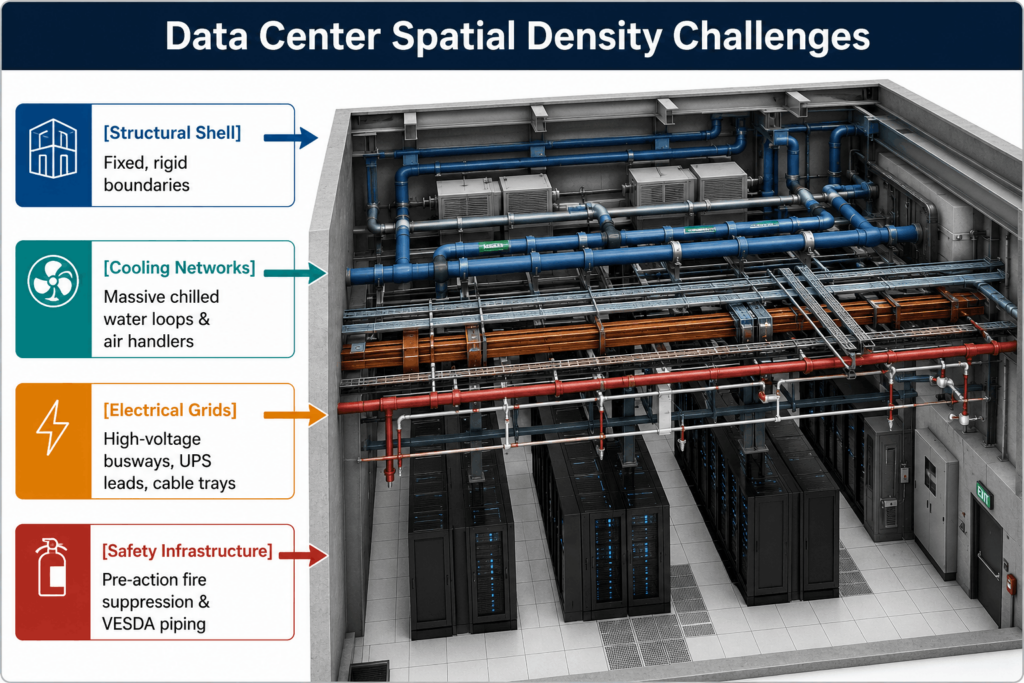
When these systems collide visually or physically during construction, the results are catastrophic. Field routing changes waste materials, stall labor forces, and compromise the structural integrity of the facility. By leveraging multi-disciplinary BIM Coordination, engineers and contractors can build the entire facility virtually first. This allows teams to identify spatial anomalies, check maintenance access clearances, and ensure that the final physical build perfectly matches the designed engineering intent.
Strategic Benefits of BIM Coordination for Data Center Projects
1. Eliminating Rework via Automated Clash Detection Services
In traditional construction workflows, spatial clashes are only discovered when a pipe physically intersects with a structural steel beam on-site. Resolving this mid-construction requires costly field orders, material waste, and idling crews.
By utilizing dedicated clash detection services, engineers combine individual architectural, structural, and MEP models into a single consolidated workspace. Software algorithms systematically scan the federated model to isolate “hard clashes” (e.g., a cable tray slicing through a condenser water pipe) and “clearance clashes” (e.g., insufficient space left to open a generator panel door). Resolving these errors in the digital phase saves hundreds of thousands of dollars in structural remediation costs.
2. Streamlining Complex Systems with MEP BIM Modeling
The lifeblood of any data center is its mechanical and electrical layout. The cooling systems required to prevent server overheating involve massive chilled water pipes, massive air handling units (AHUs), and complex ductwork. Simultaneously, the electrical infrastructure requires heavy-duty busways, uninterruptible power supply (UPS) lines, and layered communication cable trays.
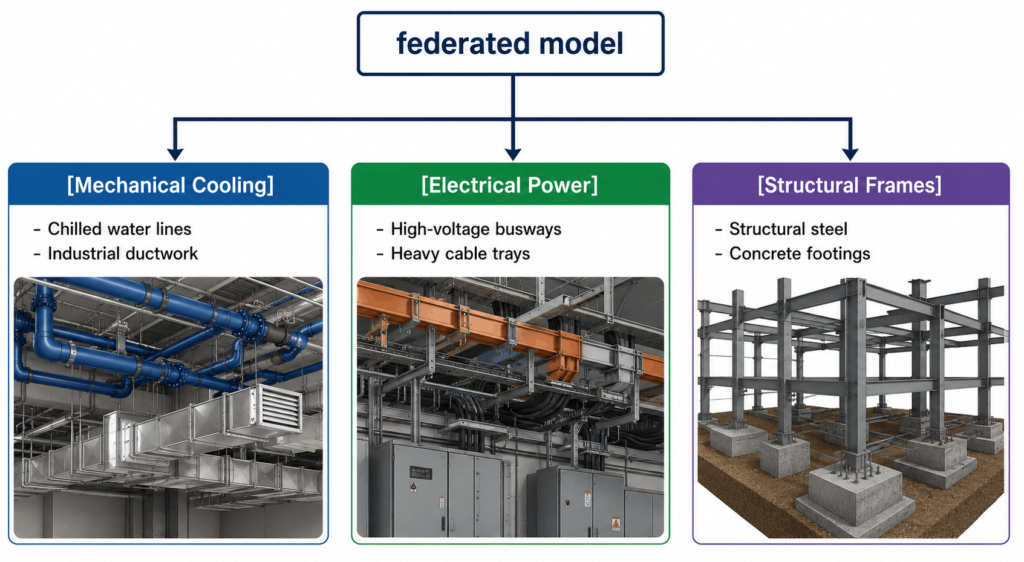
Through specialized MEP BIM Modeling, every single conduit, pipe, and bracket is detailed down to its exact millimeter coordinates. This precise mapping ensures that structural overhead supports are strong enough to carry these enormous loads and positioned properly to prevent system cross-contamination.
3. Accelerating Speed-to-Market with Pre-fabrication in Construction
In the competitive landscape of digital infrastructure, being the first to bring data storage capacity online provides a massive market advantage. Advanced BIM Coordination unlocks the ability to use extensive pre-fabrication in construction.
When your coordinated model achieves a zero-clash status, contractors can safely generate highly detailed LOD 400 shop drawings directly from the digital components. This enables manufacturers to cut pipes, assemble multi-service modular racks, and pre-wire complex electrical skids off-site in a controlled factory environment. Once delivered to the job site, these pre-assembled modules are simply lifted and bolted into place, shaving months off the total construction timeline.
Step-by-Step BIM Coordination Workflow for Mission-Critical Facilities
Successfully executing BIM Coordination for Data Center Projects requires a highly disciplined, structured sequence. Because these facilities house sensitive data center infrastructure, a chaotic modeling process will inevitably lead to gaps in system coverage or design oversights.
Acura BIM utilizes a structured, industry-proven sequence to manage complex facility coordination safely and efficiently:
1.Establish the Single Source of Truth:Project Initiation.
Set up the Common Data Environment (CDE) using platforms like Autodesk BIM 360 or Autodesk Construction Cloud. Establish strict modeling protocols, coordinate origin points, and name conventions for all participating engineering teams.
2.Develop Multi-Disciplinary Models:Modeling Phase.
Create highly detailed 3D models for all disciplines. Structural frames, concrete footings, architectural partitions, and dense mechanical/electrical layouts are modeled concurrently based on the project’s engineering specifications.
3.Execute Federated Clash Detection:Navisworks Coordination.
Merge the independent models into a unified master file. Run automated conflict tests via Navisworks coordination routines to isolate hard physical intersections and spatial clearance infractions.
4.Conduct Collaborative Resolution Meetings:VDC Collaboration.
Lead comprehensive Virtual Design and Construction (VDC) coordination sessions with project managers, engineers, and trade contractors. Systematically resolve identified clashes by adjusting routing paths based on a strict hierarchy of systems.
5.Extract Production-Ready Deliverables:LOD 400 Shop Drawings.
Once the federated model is verified completely clash-free, extract highly accurate LOD 400 shop drawings and precise material bill of quantities (BOQs) to kickstart off-site fabrication and field installation.
Overcoming Top Technical Challenges in Data Center BIM Layouts
Managing High-Density Electrical and Communication Routing
Data centers route thousands of miles of low-voltage fiber optic cables alongside heavy high-voltage power feeds. If these systems are placed too close together, electromagnetic interference (EMI) can corrupt data streams. During the BIM Coordination phase, specific clearance zones are mapped as invisible physical boundaries around high-voltage busways. This safeguards data integrity by preventing communication lines from being modeled within interference zones.
Balancing Airflow Dynamics and Liquid Cooling Systems
As server configurations pack more computational power into smaller spaces, traditional raised-floor air cooling systems are frequently augmented or replaced by liquid cooling loops. This introduces complex piping networks directly into the server rows.
Engineers use coordinated models to balance spatial priorities, ensuring that liquid lines are completely accessible for maintenance while keeping them structurally isolated from critical electrical components to eliminate water damage risks. For deeper insights into the evolutionary design principles governing these facilities, consult the comprehensive Uptime Institute Data Center Site Infrastructure Standards.
Retrofitting and Expanding Existing Legacy Facilities
Not every data center project is a clean, greenfield build. Many projects require expanding or upgrading live, operating facilities. In these brownfield environments, relying on outdated paper prints is incredibly dangerous.
VDC teams deploy 3D laser scanning to capture the exact spatial coordinates of the active facility. This point cloud data is imported directly into the design space to build hyper-accurate as-built BIM models. New infrastructure can then be designed around existing components with absolute certainty, eliminating accidental disruptions to live server racks.
Deepening Lifecycles: From LOD 400 Shop Drawings to Facility Management
The ultimate value of comprehensive BIM Coordination for Data Center Projects extends far beyond the day the facility boots up. The coordinated model acts as an invaluable operational asset across the entire lifecycle of the building.
| BIM Lifecycle Stage | Core Deliverable | Primary Operational Value |
| Design Development | Connected 3D Federated Model | Prevents design errors and aligns structural and architectural boundaries early. |
| Construction Phase | LOD 400 Shop Drawings | Fuels off-site pre-fabrication, reduces field labor hours, and eliminates material waste. |
| Project Closeout | Verified As-Built BIM Models | Provides a precise digital twin capturing all field adjustments and physical installations. |
| Facility Operations | Asset Embedded Data (COBie) | Empowers operations teams to track equipment life, manage preventative maintenance, and model thermal efficiency. |
When a facility needs an equipment upgrade or a server floor expansion years down the road, operators don’t need to punch holes in walls to find hidden conduits. They simply open their digital twin to see exactly what lies behind every panel.
Accelerate Your Infrastructure Delivery with Acura BIM
Building a modern data center requires extreme precision, deep domain knowledge, and advanced modeling technology. At Acura BIM, we help developers, engineering firms, and general contractors bring critical digital infrastructure online faster, safer, and completely clash-free.
Our expert team delivers end-to-end support, covering every phase from initial MEP BIM Modeling Services to comprehensive Navisworks coordination and production-ready shop drawings. By outsourcing your coordination needs to us, you eliminate internal resource bottlenecks, minimize field rework, and ensure your project meets its strict launch deadlines.
Don’t let unexpected field clashes compromise your budget or delay your speed-to-market. Contact the Acura BIM Engineering Team Today to request a custom quote or schedule a technical review of your upcoming project.
Frequently Asked Questions Regarding Data Center BIM
What is the ideal Level of Development (LOD) for data center coordination?
Data center projects typically require LOD 400 for all primary MEP systems and structural steel layouts. This level of detail ensures that components are modeled with accurate sizing, precise routing paths, specific fabrication data, and exact installation orientation, making the model ready for off-site pre-fabrication.
How does 3D laser scanning assist in data center expansion projects?
3D laser scanning captures millions of data points from an existing physical space to create a highly accurate point cloud. Our teams use this data to generate verified as-built BIM models. This allows engineers to design expansions and equipment upgrades around active infrastructure without risking accidental shutdowns.
Why is Navisworks preferred for clash detection services over standard design software?
While platforms like Revit are excellent for authoring models, software like Autodesk Navisworks is custom-built to handle massive, multi-disciplinary files without sacrificing system performance. It allows us to merge enormous structural, architectural, and MEP files into a single space to run automated clash tests and manage complex resolution workflows efficiently.
Can a coordinated BIM model help reduce data center operational energy costs?
Yes. A fully coordinated model can be integrated with Computational Fluid Dynamics (CFD) software to simulate airflow through server aisles. This allows engineering teams to optimize cooling layouts, eliminate hot spots, and refine overall energy consumption before purchasing any physical cooling units. For a deep look at how digital coordination impacts global energy footprints, review the IEA Data Centers and Data Transmission Networks Analysis.