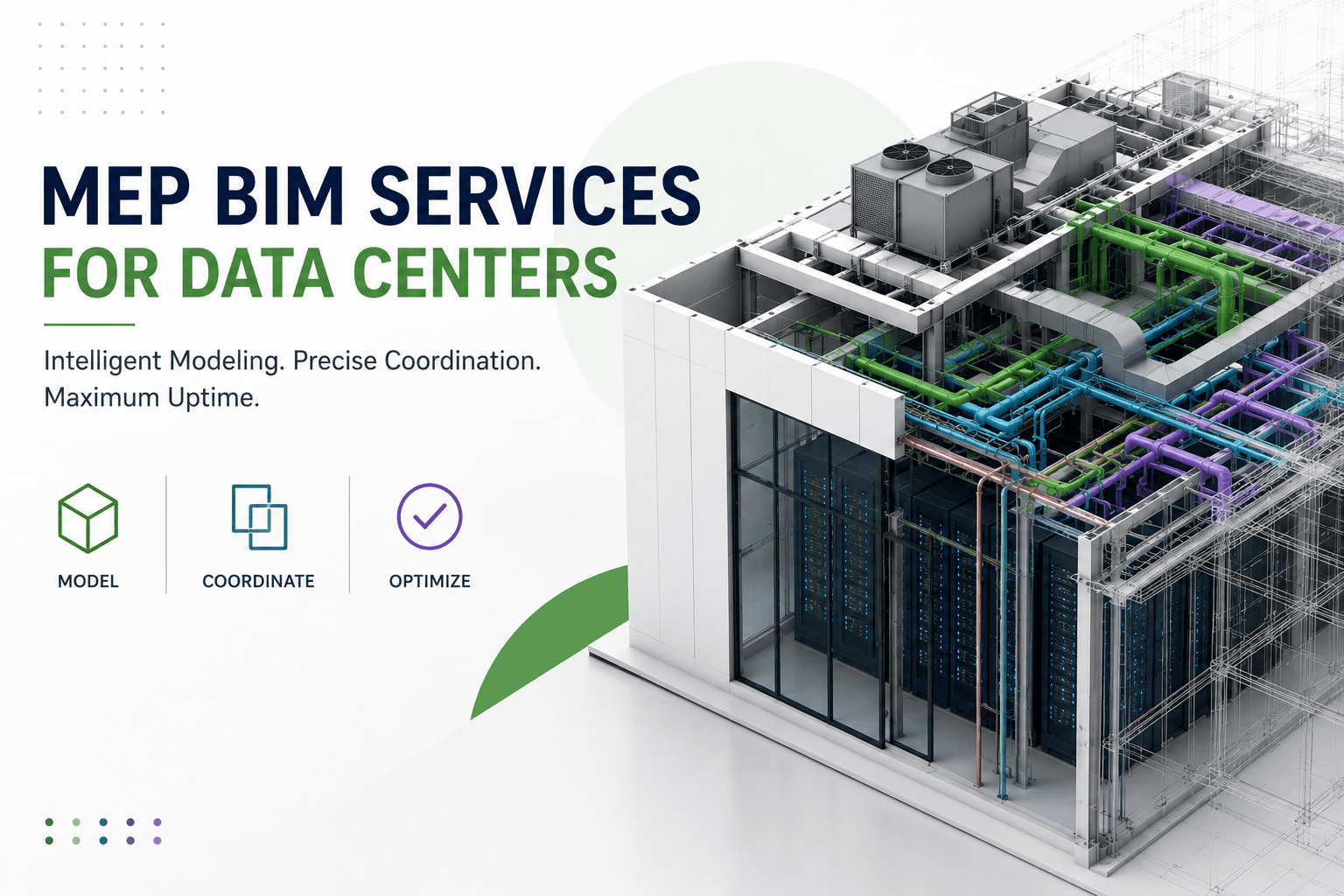
The global demand for computational power is surging at an unprecedented rate. As artificial intelligence (AI), machine learning, cloud storage, and quantum computing transition from experimental tech to enterprise necessities, traditional construction methodologies are pushed to their breaking points. Modern hyper-scale data ecosystems are among the most intricate facilities built today. They require a perfect, continuous balance between structural design, medium-voltage power generation, and massive mechanical networks. Navigating high-density power and cooling micro-environments demands zero-margin architecture. This is exactly where specialized MEP BIM Services step in.
Building Information Modeling (BIM) is no longer a luxury tool used simply for standard 3D visualizations; it has evolved into a mandatory data paradigm. For high-performance data infrastructure, implementing MEP BIM Services for Data Centers is the definitive strategy to mitigate spatial bottlenecks, optimize thermal paths, and guarantee continuous facility uptime. Standard data environments that previously managed 10 kW to 15 kW per rack must now support workloads reaching 50 kW to 100 kW per enclosure. Resolving these dense technical layouts requires building complex, multi-layered spatial models before a single component is fabricated.
Understanding the Complexity of Data Center MEP Architecture
Data facilities require much tighter integration of heavy mechanical, electrical, and plumbing systems within dense spatial footprints than standard commercial developments. Standard commercial buildings rarely face the extreme power demands, intense heat outputs, or strict redundancy mandates common in digital infrastructure.
1. High-Density Mechanical Cooling Footprints
Managing escalating thermal profiles requires a shift from traditional forced-air Raised Floor cooling to advanced, hybrid industrial liquid cooling systems. These systems include Direct-to-Chip (DTC) cooling loops, chilled-water manifold networks, and immersive multi-phase dielectric fluid tanks. Integrating these massive piping footprints alongside traditional electrical containment units requires absolute spatial precision. Engineers must visualize the airflow and heat dissipation pathways to ensure that the cooling strategy is optimized for density.
2. Redundant Electrical Distribution Networks
Mission-critical infrastructure demands continuous power availability. This requires complex routing of redundant electrical pathways (such as N+1 or 2N architectures). High-voltage switchgears, massive Uninterruptible Power Supply (UPS) modules, backup diesel generators, and extensive busway systems must coexist alongside mechanical infrastructure without a single centimeter of spatial overlap.
3. Intensive Fire Suppression and Security Containment
Because water damages mission-critical server hardware, data centers rely on specialized gas-based, clean-agent fire suppression networks or pre-action sprinkler layouts. These networks require separate, dedicated routing paths that must remain completely accessible for compliance testing and long-term maintenance.
Key Benefits of MEP BIM Services for Data Centers
Leveraging intelligent, data-rich virtual design workflows transforms how contractors, engineers, and facility owners execute complex builds. By replacing fragmented 2D drawings with unified, multi-dimensional data models, stakeholders achieve complete structural clarity.
1. Millimetric Clash Detection and Mitigation
The core advantage of deploying comprehensive virtual design workflows is automated clash detection. By integrating structural, electrical, and mechanical layouts within a unified cloud environment, engineering teams can pinpoint spatial conflicts automatically. For instance, if a structural engineer modifies a main support beam, or an electrical designer alters a high-volume cable tray route, automated protocols identify the intersection immediately. Finding a conflict digitally prevents expensive field alterations and keeps capital focused on productive asset assembly.
2. Accelerated Speed-to-Market via Modular Prefabrication
Meeting aggressive speed-to-market demands requires building components off-site while site preparations occur in parallel. When components are built off-site and assembled on-site, the margin for error is razor-thin. Advanced digital modeling generates precise spool drawings and fabrication-ready files. Whether assembling modular power skids or pre-fabricated chilled-water pipe racks, digital validation ensures a perfect, “Lego-like” fit upon arrival.
3. Integrated Asset Intelligence for Seamless Commissioning
Every asset within a data-rich 3D environment—from Computer Room Air Conditioning (CRAC) units to Power Distribution Units (PDUs)—is embedded with parametric data. This includes manufacturer metadata, performance specifications, maintenance schedules, and warranty details. Commissioning teams leverage this structured data to validate system performance, accelerate site verification, and ensure regulatory compliance.
4. Digital Twins and Predictive Operations
Beyond construction, the final model acts as a live digital twin of the operational asset. By connecting the physical structure with real-time IoT sensors, environmental monitors, and Building Management Systems (BMS), operators can monitor real-time Power Usage Effectiveness (PUE), trace structural thermal fluctuations, and predict equipment maintenance cycles before failures occur.
Overcoming Design Constraints with Advanced BIM Technologies
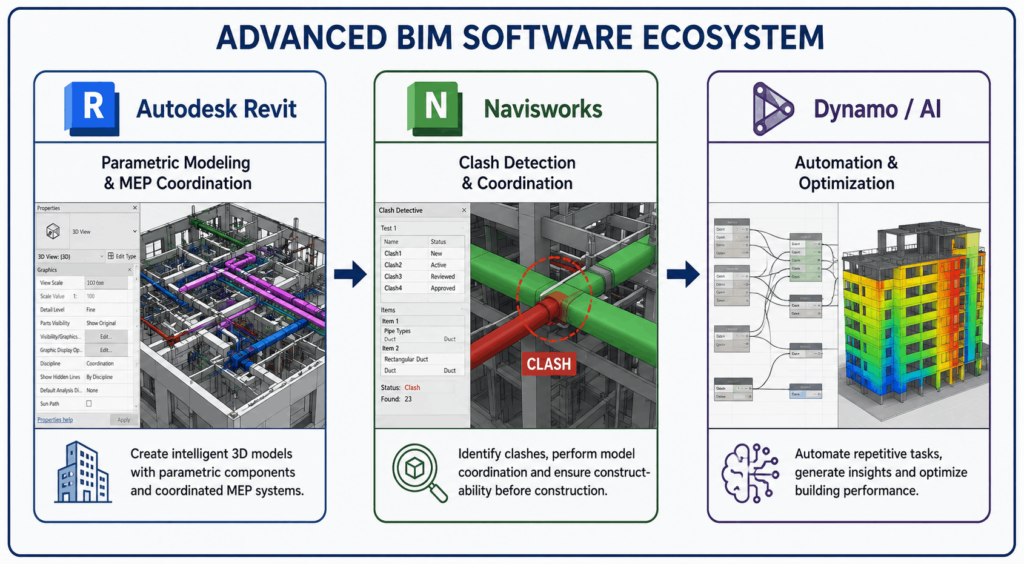
Managing complex layouts requires the deployment of industry-standard digital toolsets that support automated scripts and high-fidelity point cloud integration.
Parametric Modeling and System Integration
Using specialized tools like Autodesk Revit allows engineering cohorts to maintain absolute synchronization across all technical disciplines. Through smart parametric design, any change made to a single component instantly updates across all related technical views. This seamless link bridges the gap between architectural plans, structural engineering, and MEP designs.
Scan-to-BIM for Retrofits and Expansion
Data center deployment is not limited to greenfield construction. Upgrading or expanding existing server farms introduces substantial physical risks. Through laser scanning, field engineers generate a highly accurate “point cloud” of an existing asset. This point cloud is then converted into a functional 3D environment, allowing designers to map out new liquid cooling loops or secondary power feeds without disrupting active white space operations.
Robotic Automation and Readability
To optimize both modern data facility construction and automated component fabrication, engineering firms leverage advanced scripts and generative design principles. Robotic automation in manufacturing and readability of digital models ensure that structural components fit together perfectly. These workflows streamline everything from sheet metal cutting for custom HVAC ductwork to assembling complex electrical modules, reducing human error and boosting production speeds.
Why Acura BIM is Your Strategic Data Center Engineering Partner
Navigating the complexities of data center design requires more than just standard software access; it demands a strategic partner who understands the nuances of dense MEP coordination, strict redundancy mandates, and zero-error execution. At Acura BIM, we specialize in bridging the gap between design intent and construction reality.
Our specialized engineering team supports end-to-end data infrastructure execution through advanced BIM expertise. With 12+ years of experience delivering international BIM services across 10+ countries, we bring technical precision to every stage of your project—from initial concept to final operational handover.
Our Proven Data Center Track Record
We have delivered complete BIM coordination and MEP modeling support for mission-critical digital infrastructure projects worldwide. A prime example is our delivery for a 15+ acre hyperscale data center developed for Microsoft, where our teams resolved severe utility congestion, handled continuous design revisions, and maintained millimetric accuracy under aggressive schedules.
Our data center capabilities include:
- Comprehensive BIM Modeling (LOD 100 to LOD 500): Generating complete 3D architectural, structural, and MEP models tailored to hyperscale requirements.
- Advanced Clash Detection: Utilizing Navisworks to compile detailed conflict reports and implement proactive re-routing.
- Prefabrication and Spool Sheets: Developing fabrication-ready models to support off-site modular assembly.
- Asset Data Integration (COBie/CMMS): Structuring model information to match global buildingSMART standards for smooth handover and immediate facility management use.
Our BIM-enabled coordination workflows routinely help clients achieve a 95% reduction in field clashes, an 8% to 12% reduction in overall project costs, and 20% to 30% faster installation times, completely eliminating costly site rework.
Accelerate Your Infrastructure Delivery with Acura BIM
Don’t let design silos, coordination delays, or field reworks derail your project timeline or inflate your capital expenditures. Whether you are planning a high-density greenfield hyperscale facility, upgrading an enterprise server farm with direct-to-chip cooling, or setting up modular edge environments, our engineering cohort provides the technical expertise to keep your project on time and within budget.
Partner with India’s trusted BIM service provider to bring predictability, precision, and efficiency to your next build. Contact our data center specialists today to review your project blueprints and receive a comprehensive, tailored technical proposal.
Get in Touch with Acura BIM for Your Free Quote and Project Evaluation
Frequently Asked Questions (FAQ)
Q: How do MEP BIM services reduce data center construction costs?
MEP BIM services reduce costs by identifying and resolving design conflicts in a virtual environment before ground is broken. Resolving an intersection between an electrical conduit and a chilled-water pipe digitally costs a fraction of fixing it on-site. Additionally, accurate bill of materials (BOM) data minimizes material waste and supports efficient procurement.
Q: Can BIM modeling support the transition to liquid cooling systems?
Yes. Modern high-density environments require intricate Direct-to-Chip (DTC) cooling loops and chilled-water networks. BIM allows engineers to design, map, and visualize these dense fluid piping configurations alongside electrical infrastructure, ensuring optimized airflow and zero physical interference.
Q: What Level of Development (LOD) is typically required for data center handovers?
For effective facility operations and commissioning, data centers generally require an LOD 400 model (fabrication-ready detailing) for construction, which is updated to LOD 500 (as-built) upon project completion. This ensures the digital model accurately matches the physical asset and includes all necessary equipment metadata.
Q: How does Scan-to-BIM benefit operational data center expansions?
Scan-to-BIM uses on-site laser scanning to create a highly accurate digital replica of an existing facility. This point cloud data is imported into BIM software, allowing design teams to accurately plan upgrades or expansions—such as adding server racks or scaling up cooling loops—without risking accidental disruptions to active systems.