
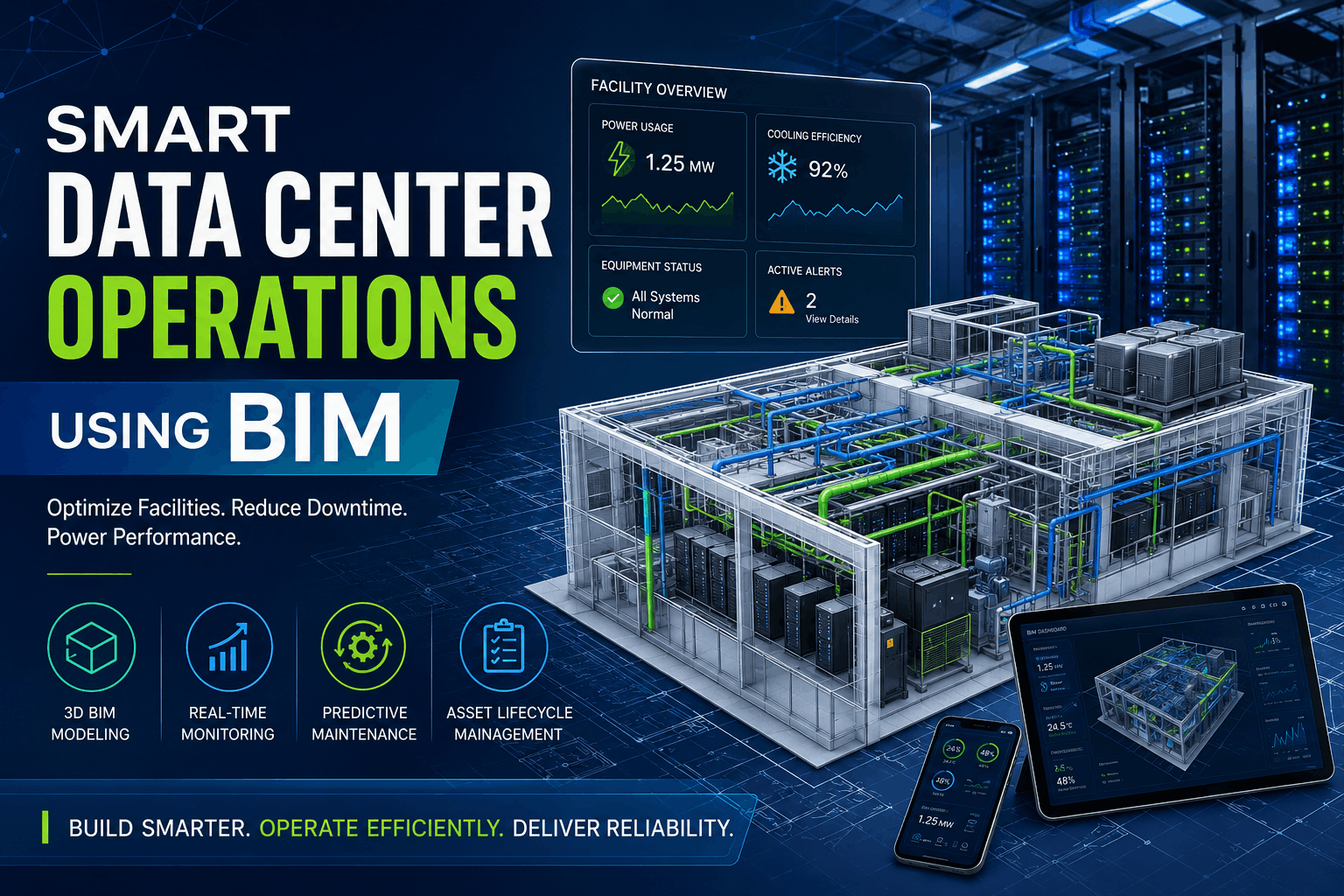
Modern mission-critical facilities are rapidly evolving. As artificial intelligence workloads, high-density computing clusters, and hyperscale demands continue to surge, traditional facility management methodologies are simply failing to keep pace. Enter Smart Data Center Operations Using BIM—a revolutionary approach that connects virtual engineering precision directly with real-time operational performance.
Building Information Modeling (BIM) is no longer restricted to the pre-construction or structural drafting phases. Today, leveraging Smart Data Center Operations Using BIM allows facility owners, operators, and engineers to transform static structural models into dynamic, data-driven operational hubs. By merging high-integrity 3D spatial models with continuous telemetry, Data Center Operations gain unprecedented clarity into power consumption, cooling efficiency, and hardware health.
In this comprehensive guide, we explore how BIM Facility Management bridges the gap between field infrastructure and digital oversight, drastically reducing downtime while optimizing total cost of ownership.
What is Smart Data Center Operations Using BIM?
At its core, Smart Data Center Operations Using BIM refers to the integration of high-detail Building Information Modeling frameworks (LOD 400–500) into daily facility management, monitoring, and maintenance workflows.
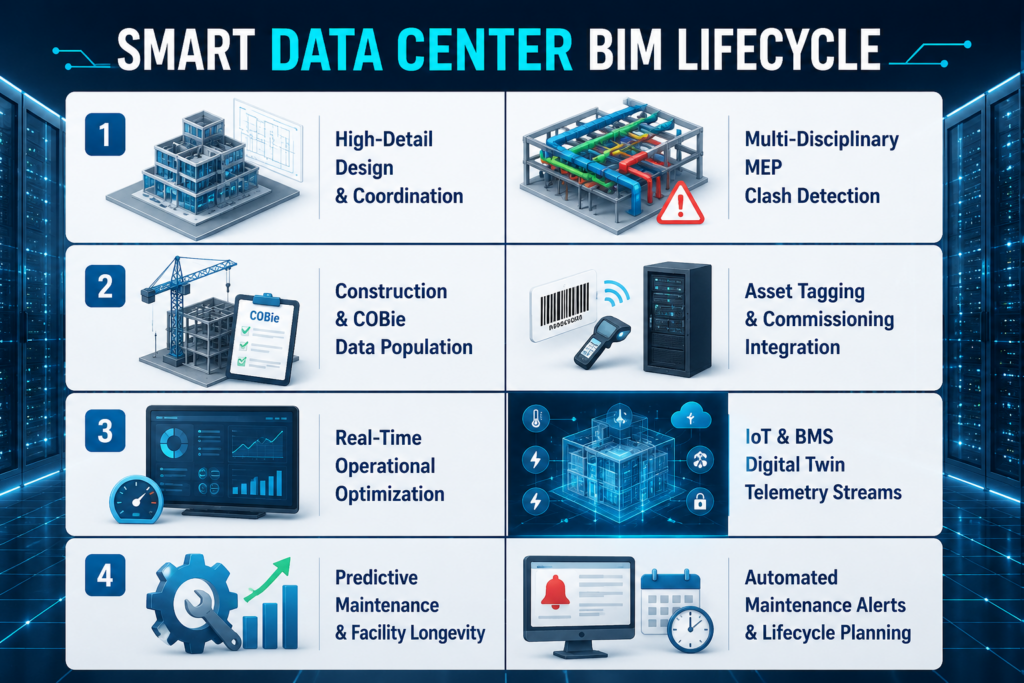
Rather than treating a building model as a static set of flat drawings, Smart Data Center Operations Using BIM turns architectural, structural, and MEP (Mechanical, Electrical, and Plumbing) models into live digital assets. When paired with Internet of Things (IoT) sensors and Building Management Systems (BMS), these models populate an interactive operational mirror—frequently referred to as a Digital Twin.
Through BIM Facility Management, operators gain immediate 3D visualization of server rack heat profiles, switchgear performance, chilled water piping networks, and electrical busway loads in real time. Consequently, facilities transition from reactive maintenance strategies toward proactive, predictive management schedules.
Key Challenges Solved by BIM Facility Management
Navigating the operational realities of a high-density facility presents singular engineering challenges. The structural footprint of modern data centers leaves zero room for error, particularly when redundant power architectures (such as 2N or N+1) double the cable and piping volume across every floor.
1. Eliminating Physical and Spatial Conflicts
Traditional facilities often suffer from crowded ceiling voids and congested raised-floor spaces. High-density cable trays, direct-to-chip cooling loops, and structural bracing frequently compete for identical physical coordinates. By enforcing systematic clash detection early in the digital lifecycle, teams resolve multi-disciplinary spatial conflicts before equipment arrives on site, guaranteeing clean physical routing during upgrades.
2. Streamlining Complex MEP Coordination
Mechanical and electrical infrastructures represent the heart of any mission-critical facility. Advanced MEP coordination ensures that cooling ductwork, chilled water manifolds, and heavy-duty Uninterruptible Power Supply (UPS) units align flawlessly. When operating the facility, engineers can trace specific piping networks or electrical runs through the 3D model without dismantling ceiling panels or tracing manual wiring schematics.
3. Preventing Unplanned Downtime
Downtime in modern Data Center Operations carries astronomical financial and reputational consequences. Outdated, disconnected drawings slow down repair cycles and elevate human error during maintenance windows. By centralizing technical data into an accessible BIM model, field technicians locate hardware, inspect specification attributes, and execute fixes swiftly and safely.
Core Components of Smart Data Center Operations Using BIM
To execute seamless Smart Data Center Operations Using BIM, several specialized technical frameworks must work in total harmony.
| Component Framework | Primary Operational Function | Business Impact |
| LOD 500 As-Built Models | Reflects exact field conditions post-construction | Ensures accurate geometry for retrofits |
| COBie Data Integration | Standardizes asset equipment records & manuals | Accelerates onboarding into CMMS/BMS |
| IoT Sensor Telemetry | Streams live heat, vibration, and power metrics | Unlocks predictive maintenance routines |
| Digital Twin Framework | Provides interactive 3D operational visualization | Reduces troubleshooting & human error |
COBie Integration and Asset Lifecycle Management
Construction Operations Building Information Exchange (COBie) serves as the critical data bridge between construction and facility handovers. During design and installation, modelers populate every server rack, air handler, generator, and circuit breaker with metadata—including manufacturer details, serial numbers, operational capacities, and maintenance schedules.
When construction concludes, this populated data imports smoothly into Computerized Maintenance Management Systems (CMMS). Consequently, facility teams avoid months of manual data entry while maintaining complete control over asset lifecycle management.
Real-Time Telemetry and Predictive Maintenance
Integrating IoT sensor data into the BIM ecosystem allows operators to monitor structural thermal fluctuations, cooling fluid dynamics, and rack power consumption on live screens.
For example, if a primary cooling pump experiences anomalous micro-vibrations, the BIM system highlights the failing unit in 3D, brings up its service manual, and flags redundant piping routes. Facility engineers perform targeted predictive maintenance long before component degradation triggers a system failure.
How BIM Optimizes Thermal and Energy Management
Energy efficiency remains one of the largest continuous operational challenges in modern digital infrastructure. High-density GPU architectures generate immense localized heat, requiring dynamic thermal management strategies.
Hot/Cold Aisle Containment Optimization
Using BIM-driven Computational Fluid Dynamics (CFD) models, engineering teams design and verify hot/cold aisle containment layouts prior to deployment. During operations, live airflow data streams back into the BIM environment. This continuous visibility enables operators to detect thermal recirculation pockets, adjust airflow dampers, and refine rack cooling distribution with surgical precision.
Optimizing Power Usage Effectiveness (PUE)
Power Usage Effectiveness (PUE) dictates operational cost structures. By combining electrical distribution topology inside the BIM model with live energy meters, operators quickly identify vampire loads, evaluate transformer efficiency, and continuously optimize overall facility PUE.
Implementing BIM Solutions for Existing Facilities
A common misconception is that Smart Data Center Operations Using BIM is restricted exclusively to brand-new, greenfield developments. In reality, brownfield facilities gain massive advantages through modern digital workflows.
By leveraging advanced Scan to BIM Conversion methodologies, specialized survey teams capture millimeter-accurate point clouds of existing facilities using high-density 3D laser scanners. Engineering teams then convert this spatial data into fully intelligent 3D models.
As a result, facility managers can confidently plan complex server hall retrofits, route high-density cooling pipe upgrades, and expand switchgear capacity without the threat of accidental utility cuts or unforeseen physical clashes.
To understand external industry standards governing asset management structures, operators often align their BIM parameters with authoritative guidelines from organizations like the Building Information Modeling Task Group and the official Autodesk BIM Resource Center.
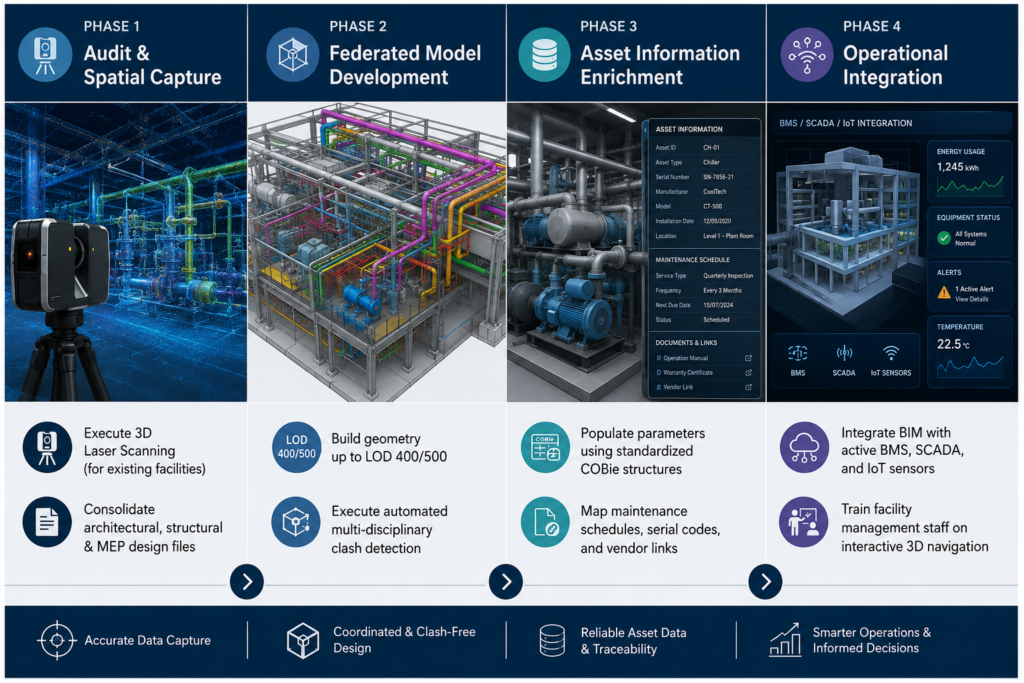
Step-by-Step Implementation Roadmap
Transitioning your facility to Smart Data Center Operations Using BIM requires a disciplined, structured methodology.
The Role of High-Precision Engineering Partners
Implementing robust BIM workflows across complex, high-density environments demands deep domain knowledge, continuous quality control, and world-class technical execution.
At AcuraBim, we specialize in delivering high-precision BIM deliverables engineered specifically for mission-critical digital infrastructure. Whether your goal involves designing multi-megawatt hyperscale environments, coordinating dense MEP distributions, or executing seamless laser-scan retrofits, our engineering groups deliver clash-free certainty from concept through operation.
Explore our comprehensive engineering solutions:
- Gain complete scheduling control with our expert 4D BIM Services.
- Ensure total physical stability with our detailed Structural BIM Modeling Services.
- Discover how our team powers critical infrastructure on our Data Center Projects portal.
Unlock Operational Peak Performance with AcuraBim
Are project delays, field reworks, or fragmented asset data holding back your facility performance? Partner with industry-proven BIM experts who understand the rigorous demands of modern mission-critical infrastructure.
AcuraBim provides end-to-end digital modeling solutions tailored to compress delivery timelines, eliminate spatial clashes, and streamline long-term facility management. Whether you are launching a hyperscale project or transforming an active enterprise facility into an intelligent Digital Twin, our specialized engineering teams stand ready to support your goals.
Ready to transform your facility management? Contact AcuraBim Experts Today to schedule a technical consultation and request a customized quote.
Frequently Asked Questions (Q&A)
Q1: What is the primary advantage of Smart Data Center Operations Using BIM over traditional facility management?
Traditional facility management relies on static 2D drawings, paper manuals, and disconnected spreadsheets, which quickly become outdated. Smart Data Center Operations Using BIM unifies spatial geometry, equipment specifications, and live IoT sensor data into a single, centralized 3D digital model. This grants facility teams instant spatial visibility, eliminates guessing during repairs, and supports predictive maintenance strategies.
Q2: How does BIM Facility Management assist with thermal and cooling optimization?
BIM Facility Management links live thermal sensors and airflow dynamics directly to 3D spatial models. By visualizing hot/cold aisle conditions in real time, operators detect cooling anomalies, balance thermal zones, and fine-tune HVAC efficiency, significantly lowering overall Power Usage Effectiveness (PUE).
Q3: Can Building Information Modeling be integrated into active, existing data centers?
Yes. Through high-density 3D laser scanning (Scan to BIM), engineers capture exact point cloud data of an active facility without causing operational downtime. This point cloud converts into an accurate, intelligence-rich BIM model that supports brownfield retrofits, expansion planning, and daily facility management.
Q4: What role does COBie play in Data Center Operations?
COBie (Construction Operations Building Information Exchange) standardizes the collection of equipment data—such as serial numbers, installation dates, warranties, and maintenance guides—during design and construction. This structured data imports directly into facility management software (CMMS), ensuring smooth operational handovers without manual data entry delays.
Q5: How does AcuraBim assist data center developers and facility operators?
AcuraBim provides end-to-end BIM services, including LOD 100–500 3D modeling, advanced MEP coordination, automated clash detection, 4D scheduling, and COBie-compliant asset models. Our specialized engineering teams help clients compress construction schedules, avoid costly field rework, and establish fully functional Digital Twins for long-term operational excellence.