
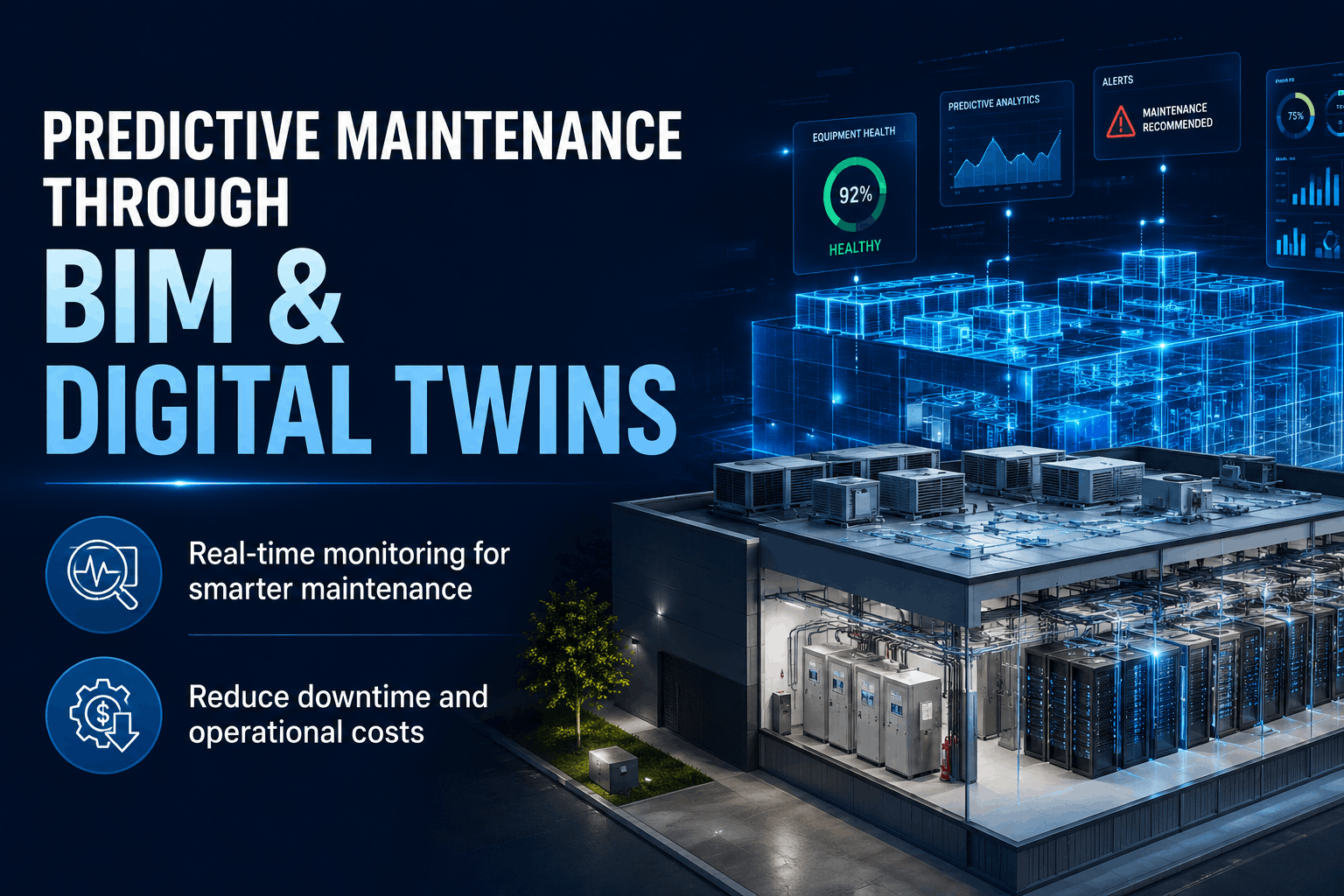
The modern technological landscape runs on continuous connectivity, cloud architecture, and hyper-scale data processing. Consequently, mission-critical facilities must maintain uninterrupted uptime. Traditional maintenance strategies often rely on reactive repairs or rigid, calendar-based servicing schedules. Unfortunately, these legacy approaches frequently lead to unexpected equipment failures, soaring operating expenditures, and costly downtime.
To combat these vulnerabilities, forward-thinking asset owners and engineering teams are turning to advanced virtual modeling methodologies. By implementing Predictive Maintenance Through BIM and Digital Twins, organizations can bridge the gap between static design blueprints and active operational management. This powerful technological integration transforms physical infrastructure into intelligent, self-monitoring ecosystems.
Understanding the Core Framework: What Are BIM and Digital Twins?
Building Information Modeling (BIM) goes far beyond basic three-dimensional drafting. It acts as an intelligent, data-rich repository that captures every geometric parameter, material specification, and component attribute of a facility. When construction concludes, this comprehensive as-built architecture serves as the foundation for a digital twin.
A digital twin is a dynamic, virtual replica of a physical structure. It synchronizes seamlessly with real-time operational metrics gathered by Internet of Things (IoT) sensors, building management systems (BMS), and power distribution units. Instead of relying on guesswork, operators can observe thermal gradients, track vibration anomalies, and assess structural loads from a centralized interface.
Predictive Maintenance Data Centers: A New Era of Operational Reliability
Deploying Predictive Maintenance Data Centers protocols requires managing intense thermal loads, complex mechanical systems, and uninterrupted power supplies. High-density server deployments generate immense heat profiles, making cooling efficiency a primary operational concern.
When facility managers integrate IoT telemetry with a data-rich 3D model, they unlock unprecedented visibility into system health. For instance, if an air handler unit (AHU) begins experiencing bearing wear, sensors detect minor vibration anomalies. The digital twin instantly flags the exact component within the spatial layout, allowing technicians to service the part before a catastrophic cooling failure occurs.
Furthermore, leveraging specialized BIM Modeling Services ensures that every mechanical, electrical, and plumbing (MEP) component is mapped with precise manufacturer metadata. This granular level of detail streamlines routine inspections and emergency interventions alike.
The Synergy of BIM and IoT for Condition-Based Monitoring
Condition-based monitoring shifts facility management from reactive firefighting to proactive asset preservation. However, raw sensor data on its own can easily overwhelm operational teams with a constant stream of alerts.
By contextualizing sensor streams within a spatial BIM environment, data gains immediate physical meaning. Operators do not just see an abstract temperature spike code; they view the exact server rack, cable tray, or transformer unit experiencing the thermal stress.
- Spatial Contextualization: Pinpoints exact equipment locations across sprawling facility layouts instantly.
- Historical Data Correlation: Compares current performance metrics against initial installation specifications.
- Automated Workflows: Triggers maintenance work orders automatically when performance deviates from established baselines.
Overcoming Legacy Maintenance Challenges in Complex Infrastructure
Legacy facility management methods struggle to keep pace with the rapid scaling of modern digital infrastructure. Paper blueprints, fragmented spreadsheets, and siloed software platforms create communication gaps between IT administrators and facilities teams.
Implementing Predictive Maintenance Through BIM and Digital Twins dissolves these operational barriers. Teams can review historical maintenance logs, verify component warranties, and simulate emergency shutdown procedures within a secure virtual environment. This level of coordination directly aligns with advanced BIM Coordination Services, ensuring that future expansions or equipment retrofits integrate flawlessly without disrupting live operations.
To explore the broader industry context surrounding asset visualization and lifecycle management, review insights on Building Information Modeling on Wikipedia.
Financial and Environmental Impact: Maximizing ROI and Energy Efficiency
Asset longevity and energy conservation represent two of the most compelling arguments for adopting advanced digital twin frameworks. Data centers consume vast amounts of electrical energy, primarily driven by continuous cooling demands and power distribution losses.
By running continuous simulations through computational fluid dynamics (CFD) connected to the digital twin, operators can optimize airflow paths and eliminate thermal hot spots. This targeted cooling control significantly reduces Power Usage Effectiveness (PUE). Moreover, preventing premature equipment failures extends asset lifecycles, protecting capital investments and minimizing material waste.
For deeper technical standards governing high-density facilities, industry professionals frequently consult guidelines from the Uptime Institute.
Accelerating Facility Resilience with Professional Engineering Support
Transitioning from traditional maintenance models to predictive, data-driven frameworks requires specialized technical execution. Constructing an accurate, data-rich digital twin demands deep expertise in multi-disciplinary modeling, clash detection, and facility management integration.
Partnering with experienced engineering specialists ensures that your facility models are built to the highest levels of detail (LOD 400 to 500), incorporating exact maintenance clearances and equipment metadata. Whether you are designing a greenfield hyper-scale facility or retrofitting an existing data center, expert support accelerates deployment timelines and safeguards operational continuity.
Elevate Your Facility Performance with Acura BIM
Ready to eliminate unexpected downtime and optimize your mission-critical infrastructure? Acura BIM delivers industry-leading virtual modeling, clash resolution, and digital twin integration tailored specifically for complex data environments. Our team of experienced engineers helps you harness the full power of spatial data to secure maximum uptime and operational efficiency.
Contact Acura BIM today to discuss your upcoming project and discover how our advanced engineering solutions can future-proof your infrastructure.
Frequently Asked Questions
What is the primary difference between a traditional BIM model and a digital twin?
While a traditional BIM model is a static, highly detailed 3D digital representation used primarily through design and construction, a digital twin is an active, living ecosystem. It connects the static BIM geometry to real-time IoT sensors and operational data feeds, allowing live monitoring and predictive analytics.
How does predictive maintenance through BIM and digital twins reduce operational costs?
By continuously monitoring equipment health and identifying anomalies before they result in failure, organizations avoid emergency repair premiums, expensive component replacements, and catastrophic downtime. Additionally, optimized cooling and power simulations lower daily energy expenditures.
Can existing data centers implement digital twin technology without shutting down operations?
Yes. Through advanced Scan to BIM workflows, engineering teams utilize high-definition 3D laser scanners to capture exact as-built conditions of active facilities. This allows the creation of precise digital twins without interrupting live server operations or utility networks.
What level of detail (LOD) is required for effective predictive maintenance modeling?
Effective predictive maintenance and facility management integration typically require models built between LOD 400 and LOD 500. These tiers incorporate exact manufacturer specifications, asset metadata, and precise physical installation dimensions necessary for accurate spatial tracking.