
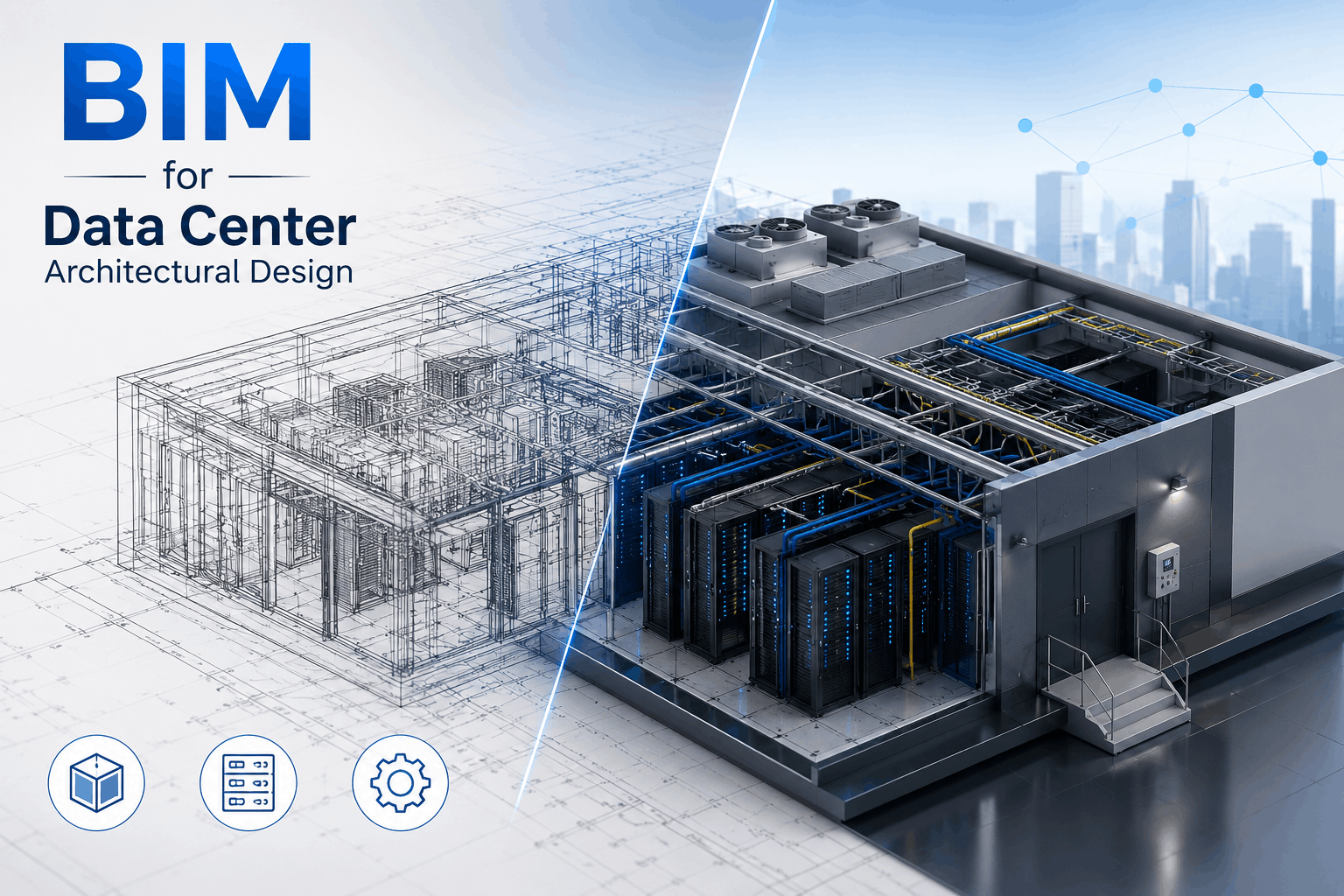
The global digital landscape is accelerating at a breakneck pace. As artificial intelligence (AI), machine learning, quantum computing, and hyperscale cloud networks transition from high-tech novelties to absolute operational essentials, traditional building methodologies are hitting a hard ceiling. Modern facilities can no longer be erected using siloed engineering approaches or static documentation. Instead, high-density server environments require zero-margin spatial precision from the very first conceptual sketch. This structural evolution demands an entirely new standard in data center architecture.
To construct an infrastructure capable of supporting heavy computing clusters, modern projects turn toward BIM for Data Center Architectural Design. Implementing Building Information Modeling (BIM) goes far beyond rendering a simple 3D visual of a building envelope. It functions as a data-driven framework that bridges the gap between raw architectural aesthetics, heavy structural loads, and ultra-complex mechanical, electrical, and plumbing (MEP) systems.
When structural design constraints intersect with multi-megawatt power infrastructure, traditional execution models fail. By establishing an advanced digital framework early in the planning phase, project stakeholders can easily prevent spatial bottlenecks, eliminate field reworks, and build a scalable ecosystem designed for long-term operational resilience.
The Complex Realities of Modern Data Center Architecture
Designing mission-critical digital infrastructure is unlike any other commercial or industrial architecture project. Standard office complexes or commercial hubs emphasize human occupancy layouts, standard ventilation setups, and aesthetic public spaces. In stark contrast, a modern high-performance data facility is built around specialized mechanical components, intense thermal profiles, and strict structural weight considerations.
As silicon chip micro-architectures push server performance limits, average rack densities are skyrocketing from historical baselines of 10 kW–15 kW per enclosure up to an unprecedented 50 kW–100 kW per enclosure. Supporting this concentration of compute power demands a massive shift away from conventional raised-floor forced-air cooling methods toward liquid cooling systems, such as:
- Direct-to-Chip (DTC) cooling manifold setups
- In-row liquid heat exchanger loops
- Immersive multi-phase dielectric fluid tanks
Integrating these large-scale fluid distribution networks alongside dense electrical busways, secondary backup power distribution units (PDUs), and heavy fire suppression setups presents a major spatial planning challenge. Without a fully coordinated 3D blueprint, physical systems will inevitably conflict on-site, leading to costly field alterations, compromised technical performance, and unexpected schedule delays.
Why BIM for Data Center Architectural Design is Critical in 2026
Building Information Modeling provides the master virtual coordinate space where spatial configuration, structural engineering, and heavy mechanical systems work together in harmony. Moving away from disconnected 2D CAD files to an integrated, cloud-enabled multi-dimensional data model ensures that all design disciplines stay perfectly synchronized.
1. Eliminating Clashes Between Structural and Spatial Layouts
A data facility is tightly packed with large electrical cable trays, massive industrial HVAC ductwork, structural steel frames, and complex security barriers. When you leverage BIM for Data Center Architectural Design, specialized virtual platforms perform automated clash detection routines across all architectural, structural, and MEP fields.
Identifying a spatial conflict on a computer screen—such as an overhead chilled-water loop running directly into a primary structural support column—allows engineers to re-route components in seconds. Fixing that exact same structural issue in the field during physical assembly requires expensive structural retrofits, delays construction timelines, and quickly drains project budgets.
2. Optimizing Floor Layouts and White Space Usage
White space is the most valuable real estate within any digital infrastructure asset. Maximizing the total number of server racks per square meter, while preserving required clearances for maintenance access, hot/cold aisle containment, and structural airflow, requires exceptional spatial precision.
Advanced architectural workflows allow design teams to test structural changes parametrically. If a primary structural support wall needs to be relocated, the layout engine instantly calculates the downstream impact on server rack spacing, raised-floor configurations, and overhead containment systems, keeping the entire plan fully optimized.
3. Boosting Speed-to-Market with Modular Pre-Fabrication
In the fast-moving digital economy, speed-to-market is a critical factor for enterprise facilities and hyperscale operators alike. By developing high-fidelity data models up to Level of Development (LOD) 400 or 500, structural components, complex modular MEP skids, and pre-wired power enclosures can be fabricated off-site in parallel with foundational groundwork. When these components arrive at the construction site, they fit together with millimetric accuracy, significantly accelerating the overall build schedule.
To explore how these advanced workflows speed up construction timelines and improve schedule predictability across complex projects, read more about our comprehensive 4D BIM Services for Smarter Planning.
Core Pillars of High-Performance Architectural BIM Services
Executing a comprehensive data center build requires specialized workflows that translate complex design ideas into accurate, fabrication-ready models. Our tailored Architectural BIM Services provide the essential structural framework needed to handle high-density equipment loads and manage intense mechanical demands.
High-Fidelity 3D Spatial Modeling (LOD 100 to LOD 500)
A project moves through distinct developmental phases, and the digital model must evolve right along with it:
- LOD 100–200 (Conceptual Design): Establishes basic spatial footprints, overall building volume, massing, and high-level area allocations for white space, grey space, and utility yards.
- LOD 300 (Detailed Design): Defines precise physical locations, exact dimensions, and spatial orientations for structural walls, primary access pathways, and main utility pathways.
- LOD 400 (Fabrication Ready): Incorporates specific manufacturer details, precise bolt configurations, assembly connections, and highly detailed spool drawings optimized for off-site pre-fabrication.
- LOD 500 (As-Built Operations): Captures the exact, field-verified physical state of the building following construction, creating an accurate digital foundation for long-term facility operations.
Structural Engineering for Heavy Equipment Loads
Modern cooling systems and heavy electrical infrastructure place massive physical loads on a building’s structure. Industrial chillers, standby diesel generators, multi-megawatt uninterruptible power supply (UPS) batteries, and liquid fluid tanks require reinforced concrete foundations and robust structural frames.
Architectural models must precisely account for these structural stresses, ensuring that the physical building shell safely balances these immense localized weights while maintaining flexible, open floor plates for future equipment upgrades.
Coordinated MEP and Intelligent Containment Routing
The true test of data center architecture lies in its ability to support dense, complex mechanical and electrical networks. The architectural model acts as the primary physical anchor for:
- Overhead Cable Tray Architecture: Managing thousands of low-voltage fiber optic runs and high-voltage power lines while avoiding structural interference with cooling ducts.
- Aisle Containment Topologies: Designing dedicated structural frames for hot-aisle or cold-aisle air isolation systems to maximize overall cooling efficiency.
- Egress and Security Zoning: Laying out clear maintenance pathways, biometric security checkpoints, and code-compliant emergency exit routes without reducing usable equipment space.
For a deeper dive into how heavy building utilities integrate into high-density industrial spaces, check out our specialized MEP Design and Drafting Services.
Step-by-Step BIM Workflow for Data Center Architecture
Building a mission-critical facility requires a structured, multi-phase modeling process. This step-by-step approach ensures that every design choice is fully coordinated, structurally sound, and ready for long-term operational success.
Step 1: Defining the Master Architecture and Spatial Zones
The process begins by establishing the master architectural model. Designers divide the facility into distinct, secure zones, separating the white space server halls from grey space utility areas, substation feeds, battery rooms, and administrative hubs. This early structure creates clean, organized zones for heavy mechanical and electrical routing down the line.
Step 2: Multi-Discipline Integration and Real-Time Coordination
Once the initial architectural layout is locked in, structural and MEP engineering teams import their technical designs into a centralized, cloud-enabled common data environment (CDE), such as Autodesk Construction Cloud (ACC) or BIM 360. This unified model ensures that all teams are continually working from the exact same master plan.
Architectural Model ──┐
Structural Details ──┼─► [ Centralized Cloud CDE ] ─► Automated Clash Reports
MEP Infrastructure ──┘
Step 3: Running Automated Clash Detection and Issue Resolution
Using advanced tools like Navisworks, coordination teams run comprehensive clash detection tests across all systems. Any identified interferences—such as a large structural support beam passing through a primary HVAC duct—are logged, assigned to specific designers, and resolved directly within the virtual model before any work begins on-site.
Step 4: Extracting Coordinated IFC Drawings and Bills of Materials (BOM)
With a fully coordinated, clash-free model confirmed, the platform automatically generates precise Issued for Construction (IFC) drawings, detailed floor layouts, and highly accurate bills of materials. This automated process minimizes estimation errors, simplifies material ordering, and helps prevent unexpected supply shortages during construction.
Step 5: Developing the Digital Twin for Long-Term Operations
The utility of the BIM model continues long after construction wraps up. The finalized LOD 500 model seamlessly integrates with on-site Building Management Systems (BMS) and real-time IoT environmental sensors. This transformation turns the static design file into an interactive digital twin, giving facility managers the precise spatial data they need to track asset performance, schedule preventative maintenance, and optimize power and cooling usage across the entire facility lifecycle.
To see these exact principles in action on major, highly complex digital infrastructure developments, review our comprehensive Acurabim Data Center Case Study for a 15+ Acre Hyperscale Project.
Overcoming Design Challenges in Hyperscale and AI-Native Facilities
The dramatic rise of AI workloads is fundamentally changing how digital infrastructure is designed and engineered. As a result, modern facility planners face a unique set of technical and spatial challenges that traditional building methods simply cannot address.
Managing Extreme Power Requirements and Structural Loading
AI-native server clusters require massive amounts of electricity, demanding dense networks of medium-voltage switchgear, massive transformers, and heavy battery backup systems. To protect the facility’s structural integrity, the architectural model must precisely coordinate the placement of these heavy electrical assets, distributing intense physical weights safely across reinforced floor plates.
Balancing High Thermal Densities with Advanced Cooling Layouts
When server racks produce up to 100 kW of heat per enclosure, standard forced-air cooling methods are no longer sufficient. Integrating advanced direct-to-chip or immersion cooling systems introduces dense networks of fluid piping, manifold pumps, and secondary containment setups into the data hall.
Architectural modeling plays a crucial role here, allowing designers to map these intense thermal patterns through precise fluid dynamics simulations, ensuring optimal fluid routing and zero structural interference.
Designing for Modular, Step-by-Step Scalability
Data needs fluctuate rapidly, meaning a modern facility must be built to scale up efficiently over time. Modern data architectures address this challenge by utilizing modular, repeatable building blocks.
This smart, modular approach allows operators to build out initial server wings while leaving designated, pre-configured zones ready for future power and cooling expansions, ensuring seamless upgrades with zero disruption to active live environments.
Maximizing Energy Efficiency and Sustainability Goals
Because data infrastructure runs 24/7/365, managing operational energy consumption is a top priority for developers and hyperscale operators worldwide. Integrating energy-focused design principles directly into the architectural modeling workflow allows projects to hit strict sustainability targets while significantly lowering long-term operating costs.
Optimizing Power Usage Effectiveness (PUE) Through Simulations
Advanced modeling platforms allow engineering teams to run highly accurate environmental simulations before groundbreaking. By testing various building orientations, structural wall insulations, and airflow layouts, designers can maximize natural external cooling opportunities and optimize interior air circulation patterns. This proactive optimization drives down overall facility Power Usage Effectiveness (PUE) and cuts ongoing utility costs.
Minimizing Construction Material Waste
Accurate, data-driven material takeoffs generated directly from a coordinated model ensure that raw construction materials are ordered to exact technical specifications. This high precision minimizes structural component waste on the job site, lowers overall procurement costs, and supports green building certifications, such as LEED or BREEAM.
For a broader perspective on how digital modeling platforms are driving sustainability and cost-efficiency trends across the global construction market, explore the authoritative industry analyses available via the Building Design+Construction Architecture Insights.
The Strategic Business Advantage of Choosing BIM
Investing in an advanced digital modeling workflow delivers a clear strategic return on investment for developers, project stakeholders, and facility operators alike.
- Significant Rework Reductions: Resolving spatial and structural conflicts digitally before construction begins can reduce field reworks and unexpected design changes by up to 95%.
- Stronger Project Cost Control: Direct, data-driven material takeoffs prevent over-ordering, improve financial transparency, and typically reduce total project delivery costs by 8% to 12%.
- Faster Construction Timelines: Seamless cross-team collaboration, clear technical communication, and the use of off-site pre-fabrication workflows can accelerate installation schedules by 20% to 30%, delivering a much faster speed-to-market.
- Streamlined Operational Handovers: Transitioning from traditional, fragmented paper documents to an organized, searchable LOD 500 asset model ensures a smooth handover, allowing facility management teams to maintain maximum uptime from day one.
To learn how advanced software automation, AI-driven scheduling integrations, and modern digital twin frameworks are reshaping project management efficiency, read our industry analysis on AI-Enabled BIM 4D and 5D Modeling Solutions.
Future Horizons: AI, Automation, and Next-Gen Data Spaces
As we look toward the future of industrial design, the integration of artificial intelligence and automated design engines is set to unlock even higher levels of structural efficiency.
Generative Design Engines for Space Optimization
Future architectural workflows will leverage generative AI algorithms to instantly evaluate thousands of structural layout options. By inputting specific constraints—such as target IT capacity, required cooling methods, and site boundaries—the layout engine automatically generates the most efficient structural configuration, ensuring optimized space usage and ideal thermal performance.
Proactive Operations with Smart Digital Twins
The integration of live asset models with autonomous machine learning algorithms will soon enable predictive facility management. Future digital twins won’t just track current power use; they will actively analyze real-time data trends to predict potential equipment failures, automatically balance structural thermal loads, and optimize cooling efficiency before any operational issues occur.
To gain a deeper understanding of the international regulations, building standards, and technical compliance mandates governing mission-critical digital developments globally, consult the comprehensive Uptime Institute Data Center Infrastructure Standards.
Partner with Acura BIM for Exceptional Mission-Critical Design
Building high-density, future-proof digital infrastructure requires exceptional precision, deep technical expertise, and a proven track record of managing complex project workflows. At Acura BIM, we specialize in delivering high-fidelity Architectural BIM Services tailored specifically to the unique demands of mission-critical facility development.
Our experienced team of engineers, modelers, and technology experts collaborates closely with project consultants, EPC contractors, and equipment manufacturers to turn complex design ideas into accurate, fabrication-ready models. We utilize top industry tools—including Autodesk Revit, Navisworks, and cloud-enabled common data environments—to eliminate layout conflicts, accelerate build schedules, and lower construction risks.
Whether you are designing a scalable edge facility, an enterprise data hub, or a massive hyperscale campus, Acura BIM provides the technical precision and advanced digital workflows needed to bring your project to life with total confidence.
Accelerate Your Next Project Lifecycle
Don’t let complex spatial conflicts, unexpected field reworks, or miscoordinated designs stall your development schedule or inflate your budget. Secure your project’s speed-to-market and ensure long-term operational success with our industry-leading modeling services.
Contact Our Data Center BIM Experts Today to schedule a technical consultation, explore our specialized capabilities, and request a detailed project quote tailored to your specific infrastructure goals.
Comprehensive Frequently Asked Questions
How does BIM for Data Center Architectural Design differ from standard commercial building design?
Data facilities are highly complex, power-dense environments built around massive mechanical systems, intense heat loads, and strict structural redundancy needs. Standard commercial buildings prioritize human occupancy layouts, simple HVAC setups, and aesthetic public spaces. Data center modeling focuses on maximizing equipment layout efficiency, coordinating intricate cooling pathways, and organizing dense electrical infrastructure within a secure building shell.
What role does clash detection play in preventing project budget overruns?
Clash detection identifies physical and spatial conflicts between different building systems within the digital model—such as a structural support column blocking an primary electrical busway routing path. Catching and resolving these conflicts virtually allows design teams to adjust layouts in seconds. Discovering the same conflict on the job site during construction requires expensive field reworks, causes material waste, and triggers costly schedule delays.
What is the value of an LOD 500 model for data facility operations?
An LOD 500 model provides an exact, field-verified digital record of the completed building. When integrated with on-site Building Management Systems (BMS) and real-time IoT environmental sensors, this model transforms into a live digital twin. This gives facility managers the accurate spatial data they need to monitor power distribution efficiency, track cooling patterns, plan preventative maintenance, and manage space utilization over the lifetime of the asset.
How does modular pre-fabrication speed up construction timelines?
High-fidelity models (LOD 400+) provide the precise manufacturing details needed to construct complex mechanical equipment skids, structural steel frames, and pre-wired power enclosures off-site in a controlled factory environment. This modular construction happens in parallel with foundational civil site work. When the pre-fabricated skids arrive on the job site, they can be assembled quickly and precisely, reducing field labor needs and cutting overall construction timelines by 20% to 30%.