
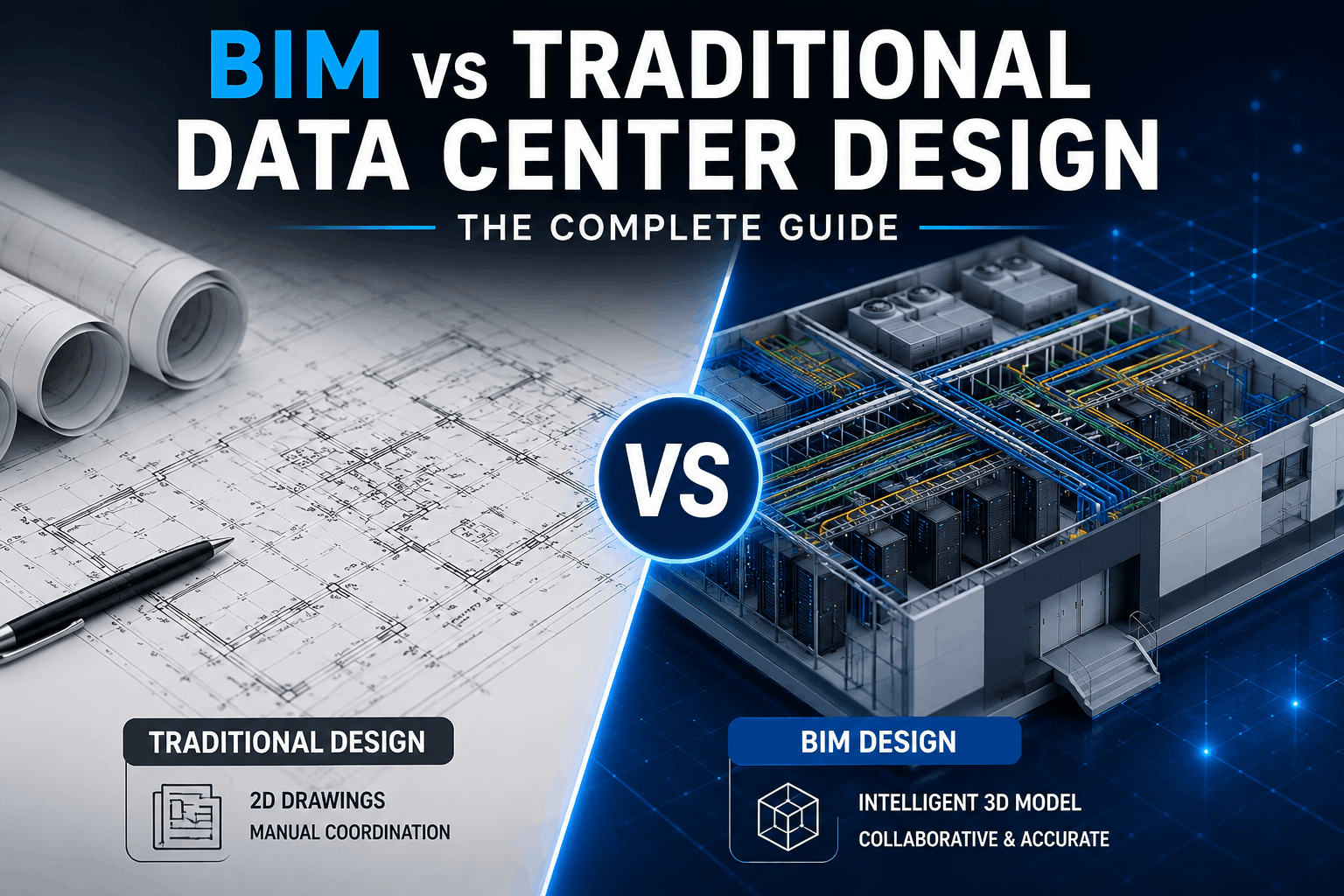
In the rapidly evolving landscape of modern infrastructure, the debate regarding BIM vs Traditional Data Center Design Methods has become a focal point for architects, engineers, and facility managers. As the demand for high-performance computing, cloud storage, and AI-driven infrastructure surges, the complexity of data center projects is reaching unprecedented levels. Historically, teams relied on fragmented, 2D-based processes. However, today’s industry leaders are pivoting toward Building Information Modeling (BIM) to minimize risk, reduce costs, and accelerate delivery timelines.
Understanding the fundamental shift between these two methodologies is not merely about choosing software; it is about adopting a philosophy that prioritizes data integrity and collaborative efficiency. In this comprehensive guide, we explore why moving beyond traditional methods is critical for the future of digital infrastructure.
The Evolution of the Data Center Design Process
The Data Center Design Process has traditionally been a linear, disjointed sequence. Architects would produce drawings, structural engineers would design the frame, and MEP (Mechanical, Electrical, and Plumbing) contractors would attempt to fit cooling and power infrastructure into the remaining space. This approach often led to late-stage discovery of conflicts, cost overruns, and scheduling delays.
Transitioning to a BIM-centric workflow changes this paradigm entirely. Rather than working in isolated silos, BIM acts as a central repository where all stakeholders contribute to a single, coordinated digital twin of the facility before a single brick is laid. This shift allows for early detection of issues, better visualization, and precise material quantification.
What is Traditional Data Center Design?
Traditional design methods—often centered around Computer-Aided Design (CAD)—rely on 2D documentation. While this approach served the industry for decades, it possesses inherent limitations when applied to the hyper-complex environment of a modern data center.
In a traditional setup:
- Siloed Communication: Each discipline works on their own sets of plans.
- Manual Coordination: Clash detection is often performed manually or visually, leading to frequent errors.
- Delayed Problem Solving: Issues are frequently identified during the construction phase, where changes are exponentially more expensive.
Consequently, traditional methods often result in “reactive” project management. When cooling systems clash with structural beams, the resolution requires extensive redesigns on-site, disrupting the critical path of the project.
BIM vs CAD: Breaking Down the Divide
To understand the core of the BIM vs Traditional Data Center Design Methods argument, one must differentiate between the tools and the methodology. A common misconception is that BIM is simply 3D CAD. This is inaccurate.
BIM (Building Information Modeling) is a process of creating and managing information on a construction project across the project lifecycle. CAD (Computer-Aided Design) is essentially a drafting tool used to produce 2D geometry.
| Feature | CAD (Traditional) | BIM (Modern) |
| Output | 2D Drawings | Intelligent 3D Model |
| Data | Geometric only | Geometric + Non-geometric data |
| Coordination | Manual/Visual | Automated Clash Detection |
| Lifecycle | Limited to design/construction | Operates throughout the facility’s life |
For a deeper look into how these workflows impact specific projects, you can view our Portfolio of BIM Projects to see how intelligent modeling translates into real-world efficiency.
The Role of VDC in Modern Infrastructure
Virtual Design and Construction (VDC) is the engine that powers BIM-based data center design. By simulating the entire construction process in a virtual environment, VDC allows project managers to “build” the data center twice—once in the digital space and once in the physical world.
This methodology is essential for complex MEP coordination. Data centers are dense with cabling, piping, server racks, and cooling units. Using BIM, engineers can visualize the airflow and heat dissipation pathways, ensuring that the cooling strategy is optimized for density. This level of precision is virtually impossible to achieve using traditional, paper-based design methods.
Why Data Center Stakeholders Choose BIM
The adoption of BIM in data center construction is no longer just a trend; it is a financial and operational necessity. Here is why industry experts are making the switch:
1. Advanced Clash Detection
By integrating structural, electrical, and mechanical models, BIM software identifies spatial conflicts automatically. If a power conduit intersects a support beam, the software flags it during the pre-construction phase. This prevents expensive rework.
2. Enhanced Cost Estimation (5D BIM)
Traditional methods rely on quantity take-offs that are prone to human error. BIM, however, links quantities directly to the model. As the design changes, the cost estimate updates in real-time. This dynamic link provides transparency that is vital for budget management.
3. Lifecycle Facility Management
Once construction is complete, the BIM model acts as a “Digital Twin.” Facility managers can access the model to identify the location of specific valves, cabling, or maintenance points without needing to sift through thousands of outdated 2D pages. For more information on how this improves operations, visit our BIM Modeling Services page.
Transitioning to BIM: Challenges and Solutions
While the benefits are clear, transitioning away from traditional methods presents challenges. Many firms struggle with the learning curve associated with new software, the interoperability between different BIM tools, and the initial investment in training.
However, the industry standard for Uptime Institute certifications and sustainability goals often requires the level of documentation that only BIM can provide. High-performing data centers are expected to meet strict power usage effectiveness (PUE) targets; BIM helps achieve this by allowing simulation of energy performance long before the facility is operational. To understand these standards better, you can explore the Uptime Institute’s guidelines on data center infrastructure.
The Future of the Data Center Design Process
As we look toward the future, the integration of Artificial Intelligence (AI) and Machine Learning (ML) into the Data Center Design Process will further widen the gap between traditional methods and BIM. Generative design, a subset of BIM, allows engineers to input parameters—such as cooling requirements, space constraints, and budget—and have the software propose thousands of optimized design iterations.
Moreover, the rise of modular data centers requires a standardized, pre-fabricated approach that is inherently compatible with BIM. When components are built off-site and assembled on-site, the margin for error is razor-thin. BIM ensures that the “lego-like” assembly of a modular data center fits perfectly every time. For insights into building standards and compliance, the National Institute of Standards and Technology (NIST) provides excellent resources on infrastructure resilience.
Partner with Acura BIM
Navigating the complexities of data center design requires more than just software; it requires a strategic partner who understands the nuances of MEP coordination, clash detection, and the full lifecycle of a facility. At Acura BIM, we specialize in bridging the gap between design intent and construction reality.
We help contractors, engineers, and owners mitigate risks and maximize efficiency. Whether you are in the planning stage of a hyperscale facility or upgrading an existing server farm, our team provides the technical expertise to ensure your project stays on time and on budget.
Are you ready to optimize your next project with industry-leading BIM solutions? Contact our expert team today to discuss your requirements and discover how we can transform your workflow. Get in touch with us for a consultation.
Frequently Asked Questions (Q&A)
Q: Is BIM more expensive than traditional CAD design?
While the upfront investment in BIM software and training is higher, BIM significantly reduces costs during the construction phase by eliminating clashes and rework. In the long term, it is almost always more cost-effective.
Q: How long does it take to implement BIM in a company currently using traditional methods?
Implementation varies depending on the size of the team. However, with the right support and pilot projects, teams often see improvements in coordination efficiency within the first 3 to 6 months.
Q: Can BIM be used for renovating existing data centers?
Absolutely. By using laser scanning to create a “point cloud” of an existing facility, you can convert an old building into a BIM model, allowing for accurate renovation planning and expansion.
Q: Does BIM replace the need for an architect or engineer?
No. BIM is a tool for architects and engineers. It enhances their capabilities, automates tedious documentation, and facilitates better decision-making, but it does not replace professional judgment and design expertise.
Q: How does BIM assist with sustainability?
BIM allows for energy analysis and environmental simulations. By modeling thermal performance and airflow, designers can create facilities that are much more energy-efficient, lowering the carbon footprint of the data center.
