
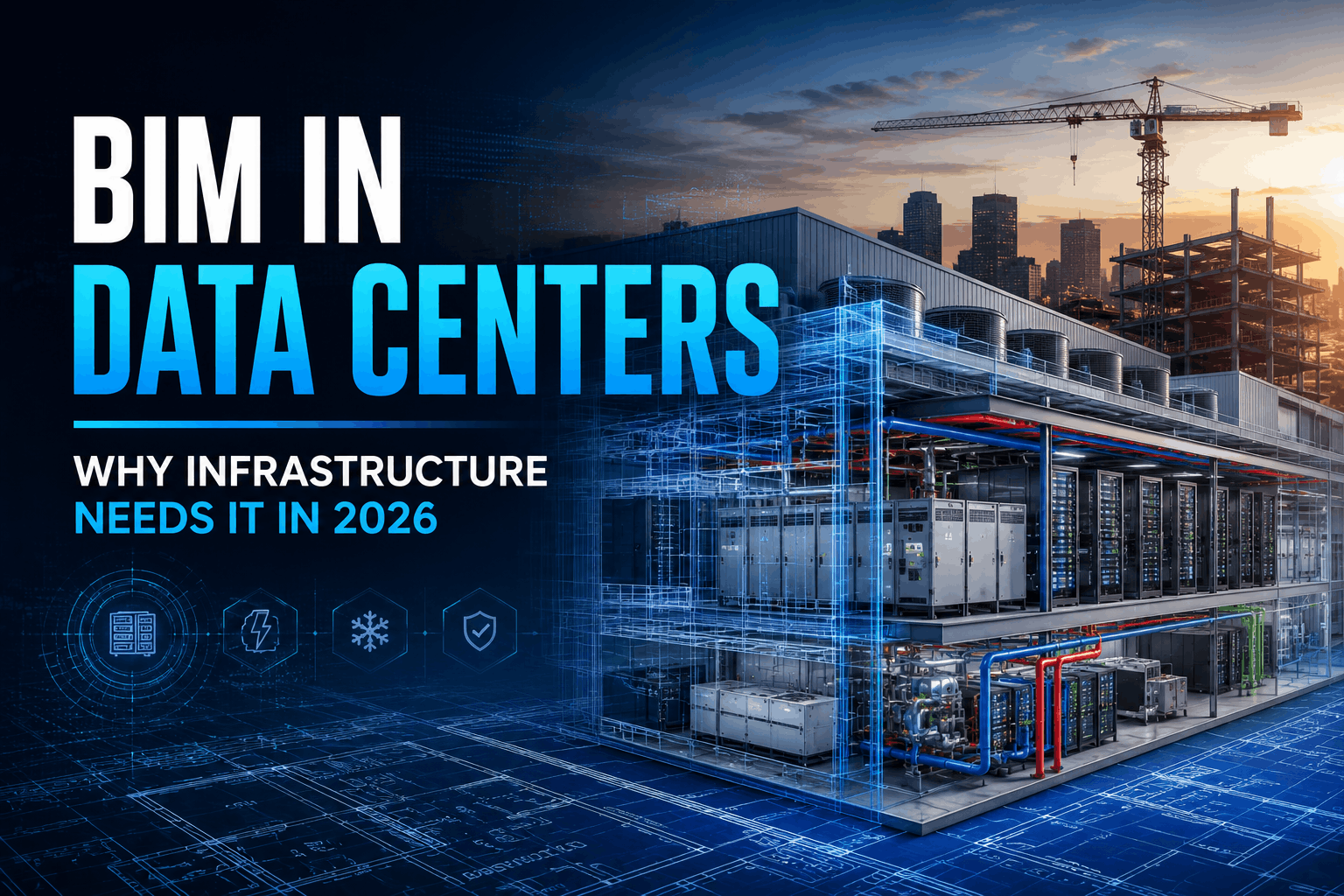
The global demand for computational power is surging at an unprecedented rate. As artificial intelligence (AI), machine learning, and quantum computing transition from experimental tech to enterprise necessities, traditional construction methodologies are pushed to their breaking points. High-density server racks, liquid cooling topologies, and hyperscale environments demand zero-margin architecture. This is exactly where BIM in Data Centers steps in.
Building Information Modeling (BIM) is no longer a luxury tool used simply for standard 3D visualizations; it has evolved into a mandatory data paradigm. In 2026, constructing or upgrading an enterprise data facility without a centralized, cloud-enabled BIM ecosystem introduces massive risks. Missing project deadlines, incurring devastating budget overruns, and engineering operational failures become highly likely.
To remain competitive in today’s digital landscapes, global operators must fundamentally change how they deploy capital assets. Let us look closely at why data centers need BIM in 2026 to achieve maximum runtime, structural flexibility, and resource efficiency.
1. Navigating High-Density Power and Cooling Micro-Environments
Modern facilities face significant physical challenges. The rapid deployment of AI-accelerated silicon architectures has caused average rack densities to skyrocket. Standard data environments that previously managed 10 kW to 15 kW per rack must now support workloads reaching 50 kW to 100 kW per enclosure.
Managing these high thermal profiles requires a shift from traditional forced-air Raised Floor cooling to advanced, hybrid industrial liquid cooling systems. These systems include:
- Direct-to-Chip (DTC) cooling loops
- Chilled-water manifold networks
- Immersive multi-phase dielectric fluid tanks
Integrating these massive piping footprints alongside traditional electrical containment units requires absolute spatial precision. Utilizing advanced BIM in Data Centers allows engineering cohorts to build complex, multi-layered spatial models. These models ensure that cold-water supply pipes, primary electrical busways, and fiber-optic runs never compete for the same physical coordinates.
By applying automated clash-detection protocols within an interactive design environment, structural planners identify and resolve layout conflicts before fabricating a single component. This proactive coordination avoids costly structural adjustments during field assembly.
2. Managing Complex Layouts with Advanced Data Center Construction Technology
Modern hyper-scale data ecosystems are among the most intricate facilities built today. They require a perfect, continuous balance between structural design, medium-voltage power generation, and massive mechanical systems.
Deploying modern data center construction technology means replacing fragmented 2D drawings with unified, multi-dimensional data models. These cloud-connected environments bridge the gap between architectural plans, structural engineering, and MEP (Mechanical, Electrical, Plumbing) designs.
| Construction Vector | Conventional 2D Deployment Risks | BIM-Driven 2026 Advantage |
| Electrical Routing | Structural field errors, delayed busway assembly | Fully mapped, millimetric 3D pathway modeling |
| Mechanical Layout | Airflow bypass issues, structural interference | Integrated fluid dynamics and exact space allocation |
| Structural Loads | Late reinforcement costs for heavy generator slabs | Parametric structural calculations tied to equipment weight |
Through smart parametric design, any change made to a single component instantly updates across all related technical views. For example, if a structural engineer modifies a main support beam, the mechanical routing path adjusts dynamically. This level of automation prevents downstream coordination errors, helping fast-tracked projects stay on schedule and under budget.
3. Meeting Speed-to-Market Demands Through Modular Pre-Fabrication
In the modern digital economy, timing dictates market leadership. Hyperscale operators and colocation enterprises face intense pressure to commission live technical space faster than ever before. To hit these aggressive targets, the industry relies heavily on offsite modular assembly and pre-fabrication methodologies.
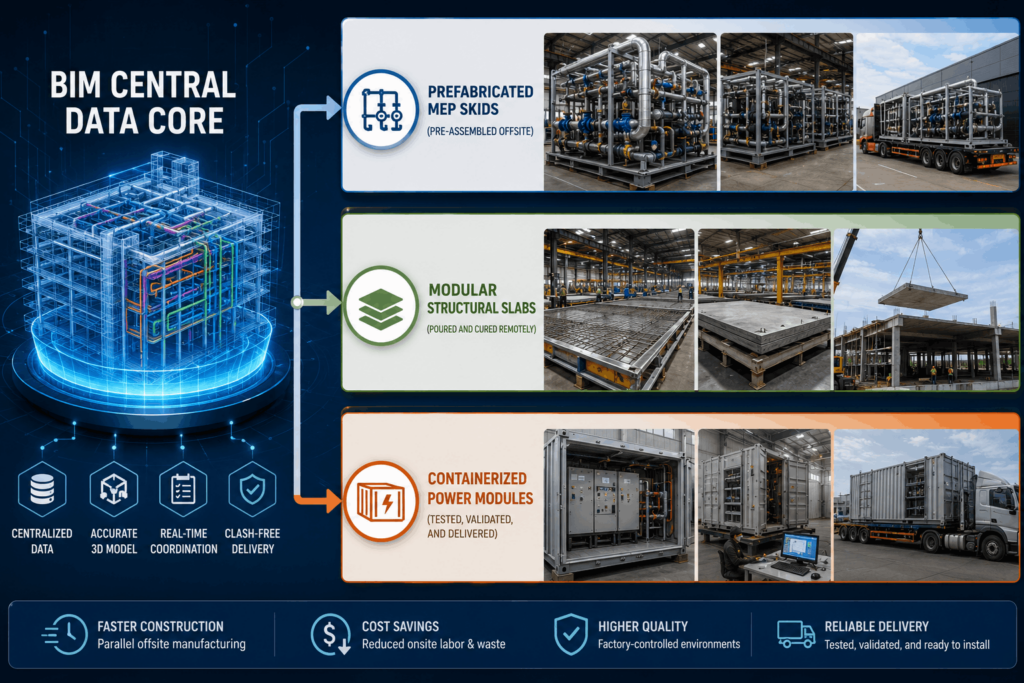
BIM serves as the foundational data source for this industrial pre-fabrication workflow. Engineers can extract precise component dimensions directly from the central model to drive automated manufacturing processes. Prefabrication teams build complex mechanical skids, containerized power modules, and massive generator enclosures offsite under controlled laboratory settings.
When these modular sections arrive at the construction site, they fit together seamlessly with minimal field adjustments. This approach reduces manual field labor, lowers worksite safety risks, and accelerates overall construction timelines by months.
4. Mitigating Material Constraints via Predictive Procurement
Global supply chains remain highly volatile. Crucial infrastructure assets—such as high-voltage transformers, backup diesel generators, customized switchgears, and specialized chillers—frequently face long manufacturing lead times. Delays in acquiring these critical components can stall an entire construction project.
Integrating advanced scheduling directly into the 3D model allows project managers to unlock predictive material tracking. This integration provides real-time visibility into material requirements:
- Accurate Material Take-offs (MTOs): Automatically extract exact material quantities to eliminate purchasing guesswork.
- Dynamic Lead-Time Insights: Connect component delivery schedules directly to the building model.
- Optimized On-Site Logistics: Stage deliveries precisely when needed to prevent on-site clutter and material degradation.
Using these automated workflows ensures that long-lead equipment is ordered, tracked, and delivered exactly when the site is prepared for installation.
5. Transitioning from Construction Model to Operational Digital Twin
The value of an optimized data model extends far past the initial construction phase. Once construction wraps up, the model transforms into an invaluable operational asset: a live Digital Twin.
By connecting the physical asset’s structure with real-time IoT sensors, environmental monitors, and BMS (Building Management Systems), operators build an interactive digital replica of their facility. This live model allows site engineers to monitor real-time power usage effectiveness (PUE), trace structural thermal fluctuations, and predict equipment maintenance cycles before failures occur.
When a critical cooling pump or electrical breaker requires servicing, technicians use the digital model to instantly locate the exact asset, view its historical maintenance records, and pull up operational manuals. This data-driven approach minimizes critical facility downtime and maximizes runtime reliability.
6. Elevating Environmental and Sustainable Lifecycle Engineering
Global regulatory bodies are introducing stricter environmental mandates for digital infrastructure projects. Modern facilities must optimize their resource consumption, closely tracking metrics like water usage effectiveness (WUE) and overall carbon footprints.
Using advanced modeling frameworks allows engineering cohorts to run accurate environmental simulations early in the design phase. Designers can test multiple airflow configurations, analyze structural solar heat gain, and evaluate alternative materials to lower the facility’s carbon footprint.
Furthermore, these intelligent asset models track the circular lifecycle of building components. This ensures that future renovations, expansions, or decommissioning processes can be executed with minimal environmental impact.
7. Maximizing Capital Efficiency and Reducing Rework Costs
Unplanned changes and field reworks have historically been a major source of financial loss in complex infrastructure projects. When specialized field teams encounter spatial conflicts on-site, resolving those issues requires expensive modifications, custom material orders, and lengthy project delays.
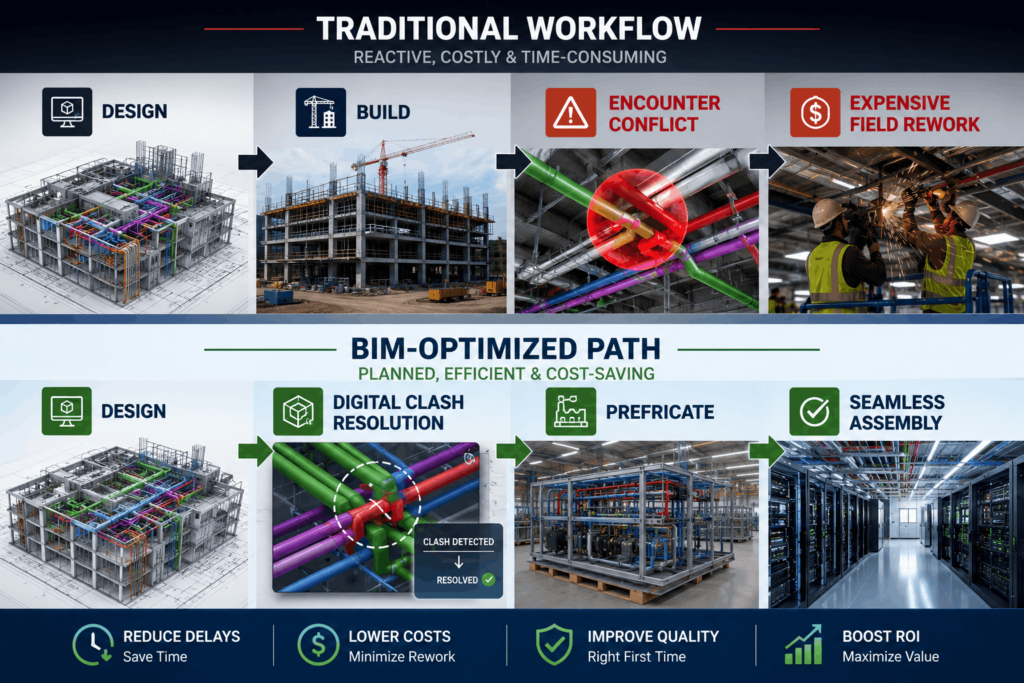
Implementing a strict modeling workflow helps prevent these budgetary challenges. Resolving design discrepancies digitally before breaks ground ensures that capital is spent exclusively on productive assembly rather than corrective field alterations. This disciplined financial control helps keep complex investments highly profitable.
Partnering with Acura BIM for Next-Gen Infrastructure Delivery
Building a high-performing digital facility requires deep domain expertise, advanced software proficiency, and proven structural experience. Organizations need an engineering partner that understands how to translate complex technical requirements into actionable, constructible data models.
Acura BIM delivers comprehensive modeling solutions tailored specifically for modern technology facilities. Our elite engineering groups specialize in high-detail MEP coordination, automated clash resolution, and operational model delivery. We help operators compress execution timelines, lower project risk profiles, and build resilient, future-ready infrastructure assets.
Whether you are launching a hyperscale development or retrofitting an active enterprise facility, our advanced workflows ensure your project sets the standard for quality and efficiency.
Let’s Discuss Your Next Project
Are you ready to streamline your next infrastructure deployment? Contact the AcuraBim team today to request a comprehensive consultation. Let us show you how our professional modeling services can optimize your design schedules, eliminate field errors, and maximize your long-term operational returns.
Frequently Asked Questions (FAQ)
1.What defines the role of BIM in Data Centers compared to standard commercial real estate projects?
Data facilities require much tighter integration of heavy mechanical, electrical, and cooling systems within dense spatial footprints. Standard commercial buildings rarely face the extreme power demands, intense heat outputs, or strict redundancy mandates common in digital infrastructure. Specialized modeling keeps these complex, interlocking systems perfectly coordinated down to the millimeter.
2.How does modeling support modern liquid cooling systems?
Liquid cooling introduces an intricate network of supply and return lines, manifolds, and fluid loops alongside sensitive power delivery pathways. Modeling gives engineers the exact spatial tracking needed to route fluid lines safely, implement necessary structural containment features, and completely avoid leaks or spatial conflicts with nearby electrical infrastructure.
3.Can an existing facility be converted into a digital model?
Yes. Using advanced laser scanning (LiDAR), field teams can capture the exact geometry of an active facility and convert that spatial data into a highly precise model. This process allows operators to confidently plan complex retrofits, optimize available footprints, and update legacy building documentation without interrupting ongoing operations.
4.How does this technology lower overall project risks for investors?
It provides a single, verifiable source of truth for the entire project team. Eliminating communication gaps between architects, field engineers, and fabricators significantly reduces unexpected structural changes, keeps procurement schedules accurate, and ensures the facility is completed on time and on budget.