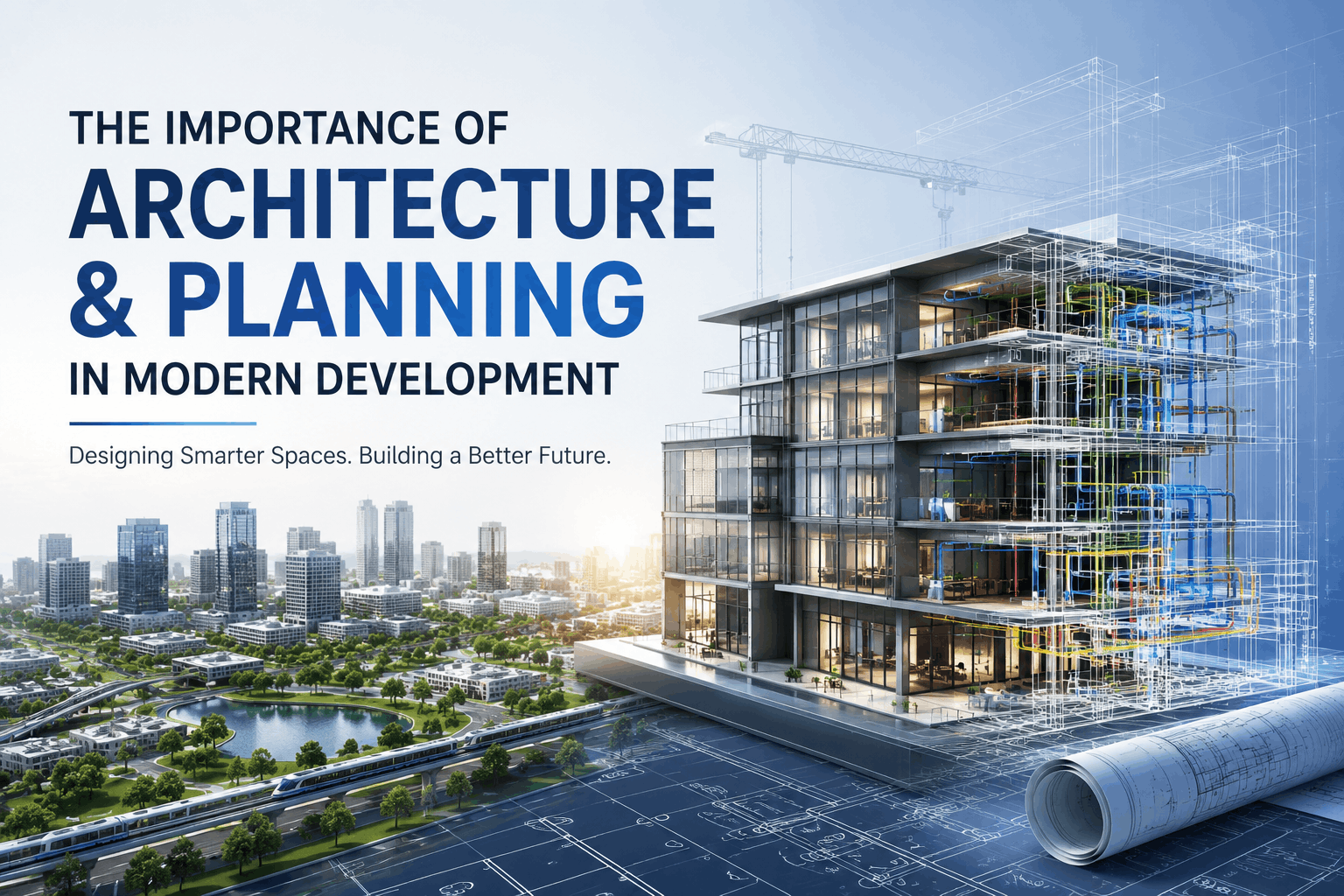
The physical landscape of our global communities is undergoing an unprecedented evolution. As populations skyrocket and metropolitan zones expand, the strategic implementation of Architecture and Planning serves as the bedrock for all sustainable progress. Modern construction is no longer just about erecting tall concrete structures; it is about creating interconnected, highly efficient systems that harmonize human life with the natural environment. When project stakeholders prioritize comprehensive spatial coordination and advanced technical execution right from the blueprint phase, they guarantee long-term asset viability. Sustainable growth requires a meticulous approach that bridges creative design with practical structural engineering to prevent the common pitfalls of urban stagnation.
For real estate developers, asset managers, and civil authorities, understanding the deeper business intelligence behind structural design is non-negotiable. Designing an iconic building or an expansive residential district requires more than basic aesthetics; it demands an intricate knowledge of spatial optimization, localized zoning laws, and smart resource allocation. By leveraging cutting-edge methodologies like detailed 3D building modeling and multi-tiered site mapping, modern development shifts from an unpredictable gamble into a predictable science. Building spaces that withstand the test of time while delivering massive financial returns requires a deliberate, digitally integrated strategy.
The Intersection of Architecture and Planning: The Foundation of Smart Infrastructure
To understand why modern developments succeed or fail, we must look closely at how building design interfaces with macroeconomic zoning. Architecture provides the specialized, granular vision for individual spaces, ensuring they are safe, visually engaging, and highly functional. Conversely, urban planning offers the macro-level framework that binds these independent structures into a unified, working ecosystem. When these two fields function in perfect synchronization, the result is highly optimized, intelligent infrastructure.
Without this collaborative alignment, cities quickly suffer from disorganized urban sprawl, congested transit corridors, and severe environmental degradation. True commercial real estate value is unlocked when an individual asset is meticulously tailored to fit cleanly into the surrounding municipality’s long-term infrastructure roadmap.
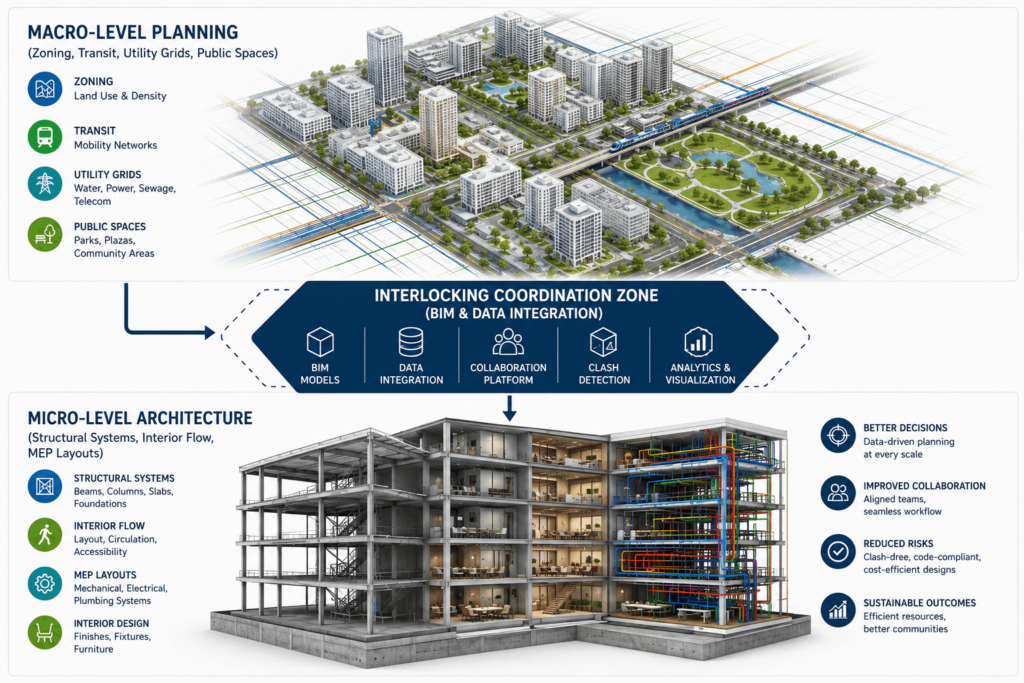
In the current development landscape, achieving this level of cross-disciplinary synergy requires advanced digital twins and spatial visualization. Designers must actively project how a building’s massing, pedestrian entry points, and energy consumption profiles will affect the immediate neighborhood across a multi-decade lifecycle. This comprehensive planning phase mitigates risk, ensures compliance with municipal guidelines, and accelerates pre-construction approvals. By establishing this strong multi-tiered foundation, developers can confidently scale projects without fearing future infrastructure bottlenecks.
1. Transforming Urban Spaces with Building Information Modeling (BIM)
The absolute cornerstone of modern Architecture and Planning is the transition from flat 2D drafts to rich, multi-dimensional data networks. Implementing Acura BIM Services completely revolutionizes how multidisciplinary project groups collaborate across complex project lifecycles. Rather than working in disconnected data silos, structural engineers, MEP specialists, and master planners can now operate inside a centralized, single source of truth.
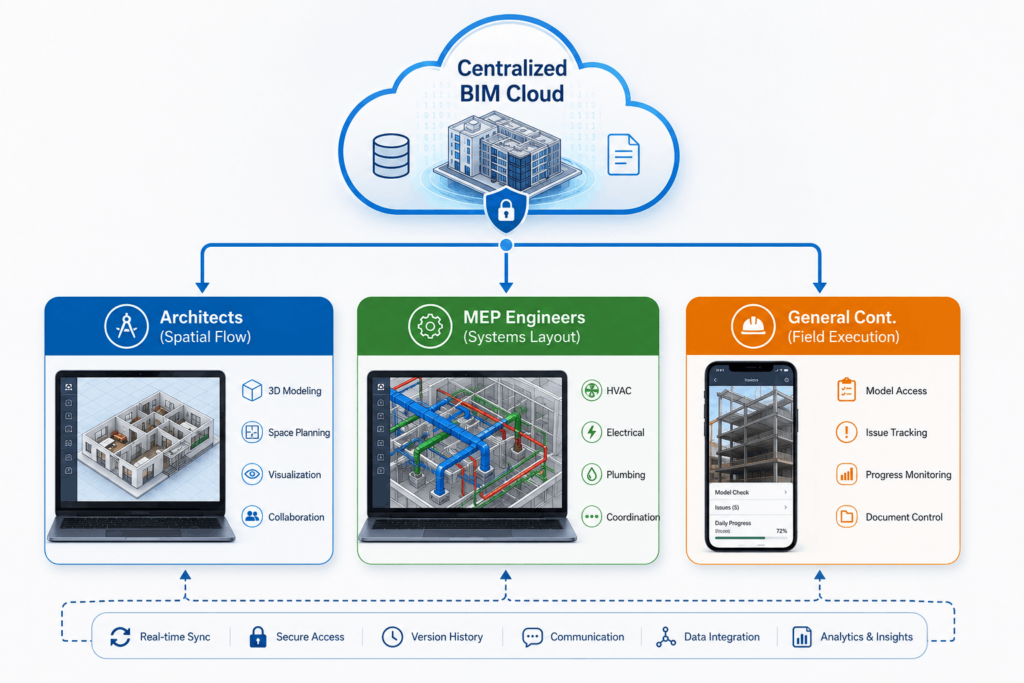
BIM modeling goes far beyond basic 3D visualization by embedding physical, mechanical, and behavioral performance data directly into every digital element. This data-rich environment gives development teams unparalleled advantages during pre-construction:
- Automated Clash Detection: Finding spatial conflicts between heavy structural steel beams and complex HVAC duct networks virtually before a single piece of material is ordered.
- Highly Accurate Cost Estimation (5D BIM): Dynamically linking the visual building model straight to the bill of materials to eliminate sudden budget overruns.
- Optimized Construction Sequencing (4D BIM): Simulating the entire step-by-step assembly process online to compress active on-site build timelines.
By removing human error and guesswork from field operations, virtual construction modeling turns high-risk structural concepts into precise, highly executable assembly sequences.
2. Navigating the Complexities of Spatial Organization and Land Use
Every successful physical development depends directly on highly calculated spatial optimization and intelligent land use programming. Maximizing raw square footage profitability while fully respecting local zoning restrictions is an art form in itself. Experienced developers recognize that poor floor plan layouts and inefficient site circulation can permanently damage an asset’s overall market valuation.
Modern spatial engineering ensures that real estate assets remain highly versatile and adaptable over decades of use. This planning requires strategic calculations regarding floor-area ratios (FAR), pedestrian traffic patterns, and flexible structural grids that can easily scale as market demands shift.
Furthermore, integrating advanced spatial intelligence directly protects a project from early obsolescence. By analyzing micro-demographics and regional economic indicators during the early site planning phase, developers can build layouts that naturally attract premium commercial tenants and maintain high long-term occupancy rates.
3. Prioritizing Sustainable Construction and Environmental Engineering
In an era defined by stricter environmental regulations and rising resource scarcity, eco-conscious development has shifted from an optional marketing tool to a core financial requirement. Incorporating sustainable construction methodologies into the Architecture and Planning phase ensures projects drastically lower their carbon footprints while slashing daily operating expenses.
Modern environmental engineering leverages smart passive design, which utilizes the local geography, wind patterns, and solar paths to naturally heat, cool, and illuminate spaces. This is paired with high-performance active systems like smart greywater reclamation loops and automated energy management networks. By optimizing the building envelope and specifying low-emission, locally sourced building materials, forward-thinking projects consistently earn prestigious green building certifications like LEED and BREEAM. These certifications directly translate into higher property valuations and substantially lower long-term overhead costs.
4. Driving Economic Growth Through Strategic Real Estate Development
The long-term economic strength of any growing city is deeply tied to the quality of its real estate development blueprints. Well-conceived commercial hubs, industrial centers, and mixed-use districts act as powerful financial engines that create jobs, boost local commerce, and expand municipal tax bases. However, sustainable economic growth does not happen by accident; it requires rigorous market analysis combined with highly precise spatial planning.
When strategic architectural assets are intentionally positioned along major public transit hubs, they spark highly lucrative transit-oriented developments (TODs). This deliberate alignment makes properties highly accessible, driving consistent consumer foot traffic and raising surrounding land values. For investment groups, partnering with an elite team specializing in advanced virtual design and detailing is the ultimate way to de-risk investments and secure predictable, high-yield returns.
5. Harnessing Architectural Visualization to Secure Project Approvals
One of the biggest bottlenecks in modern real estate development is navigating complex public hearings and securing municipal building permits. Creative concepts can easily get lost in translation when presenting intricate engineering prints to non-technical city boards, zoning committees, or investment partners. This communication gap is where high-end architectural visualization becomes a true competitive advantage.
Using immersive 3D renderings, virtual walk-throughs, and augmented reality site overlays, development groups can showcase exactly how a proposed structure will look and function within its real-world environment.
Photorealistic visualization gives stakeholders immediate clarity on how a project handles shadow casting, pedestrian flow, and aesthetic integration with neighboring historic properties. By explicitly demonstrating compliance and community value visually, developers can easily bypass months of bureaucratic delays and secure rapid project buy-in.
6. Streamlining Field Execution with Advanced MEP Coordination
A brilliant architectural concept is only as good as its actual mechanical execution. Deep inside the walls of any modern building lies a highly complex maze of mechanical, electrical, and plumbing (MEP) systems that require rigorous engineering coordination. If these vital conduits are not meticulously mapped out during the early Architecture and Planning stages, fields crews will inevitably face massive on-site installation conflicts.
Utilizing dedicated MEP coordination workflows ensures that complex spatial routing—such as massive commercial gravity-fed drainage lines, medical gas piping, and high-voltage electrical trays—is fully resolved long before construction begins. This digital validation enables off-site prefabrication, where trade contractors can pre-assemble intricate pipe spools and duct modules in a controlled factory setting. This seamless integration slashes field labor hours, minimizes material waste, and ensures structural systems operate at peak efficiency.
7. Preserving Cultural Identity via Contemporary Regional Architecture
As globalization accelerates, many modern cities risk losing their unique visual identities to generic glass-and-steel skyscrapers. The challenge for modern designers is to balance cutting-edge building performance with the preservation of local cultural heritage. This delicate balance is achieved through contemporary regional architecture—a philosophy that blends local building traditions and native materials with state-of-the-art structural engineering.
This approach allows new developments to honor their historical contexts while fully delivering the modern efficiencies of a new build. Integrating regional elements protects a city’s historical character, fosters strong community pride, and creates highly memorable environments that drive tourism and long-term cultural investment.
The Workflow of Modern Development Execution
To bring a complex asset from an initial concept to a successful handover, project teams must follow a highly structured, data-driven framework. The chart below breaks down how advanced digital engineering and spatial validation operate across each major development phase:
1.Macro Spatial Planning and Zoning Feasibility:Phase 1: Discovery.
Planners thoroughly analyze regional GIS mapping data, localized zoning laws, environmental impact limitations, and municipal infrastructure capacities to define the project’s optimal boundaries and development scale.
2.Schematic Design & Initial BIM Modeling:Phase 2: Architecture.
Design teams translate the approved spatial concepts into a data-rich 3D BIM model, establishing the foundational layout, structural massing, and initial spatial relationships.
3.Multidisciplinary MEP Coordination & Clash Resolution:Phase 3: Engineering.
Structural, architectural, and MEP models are merged into a single system. Automated clash detection protocols identify and resolve geometric conflicts entirely in software.
4.Off-Site Prefabrication and Accelerated Field Assembly:Phase 4: Construction.
Validated digital models are sent directly to manufacturing plants for precision off-site prefabrication. Components arrive on-site ready for rapid, error-free installation.
Partner with Acura BIM to Streamline Your Next Project
Successfully executing complex commercial and residential projects requires an experienced technology partner who knows how to optimize workflows and protect your bottom line. We provide a comprehensive suite of digital twins, precision spatial plans, and advanced engineering coordination services tailored to meet your exact design requirements.
Our specialized teams leverage industry-leading software platforms like Autodesk Revit and Navisworks to eliminate expensive field re-work, compress build schedules, and maximize total square footage profitability. Let us transform your complex design concepts into clean, highly executable, data-driven structural assets.
Our Specialized Engineering Solutions Include:
- Comprehensive 3D Building Information Modeling (BIM) across all design phases
- Advanced MEP Clash Detection and multi-trade spatial coordination
- High-fidelity architectural visualization and interactive client walkthroughs
- Precision quantity takeoffs and data-rich models for lifecycle asset management
Take the guesswork out of your pre-construction phase. Contact the AcuraBim team today to receive a detailed technical consultation and custom quote for your upcoming development.
Frequently Asked Questions Regarding Modern Development
1.How exactly does integrating Architecture and Planning lower total project costs?
Integrating macro planning with micro architecture via BIM allows project teams to catch and resolve structural and mechanical conflicts during the digital design phase. This prevents expensive field modifications, material waste, and scheduling delays during active construction, saving developers millions in capital expenditures. For further reading on standard construction documentation and compliance definitions, review the U.S. General Services Administration (GSA) BIM Guidelines.
2.What role does BIM modeling play in securing green building certifications?
BIM models store precise material data, track embodied carbon metrics, and simulate real-world energy performance and daylighting. This data-driven validation allows engineers to easily optimize insulation levels, manage solar heat gain, and provide verifiable documentation directly to green building councils like LEED. To benchmark international sustainability frameworks, explore the World Green Building Council.
3.Why is transit-oriented development considered a major priority for modern urban planners?
Transit-oriented development places high-density residential and commercial assets within easy walking distance of major public transit hubs. This reduce local traffic congestion, lowers personal carbon emissions, and creates highly resilient, walk-friendly neighborhoods that generate higher long-term property values and commercial returns.
