
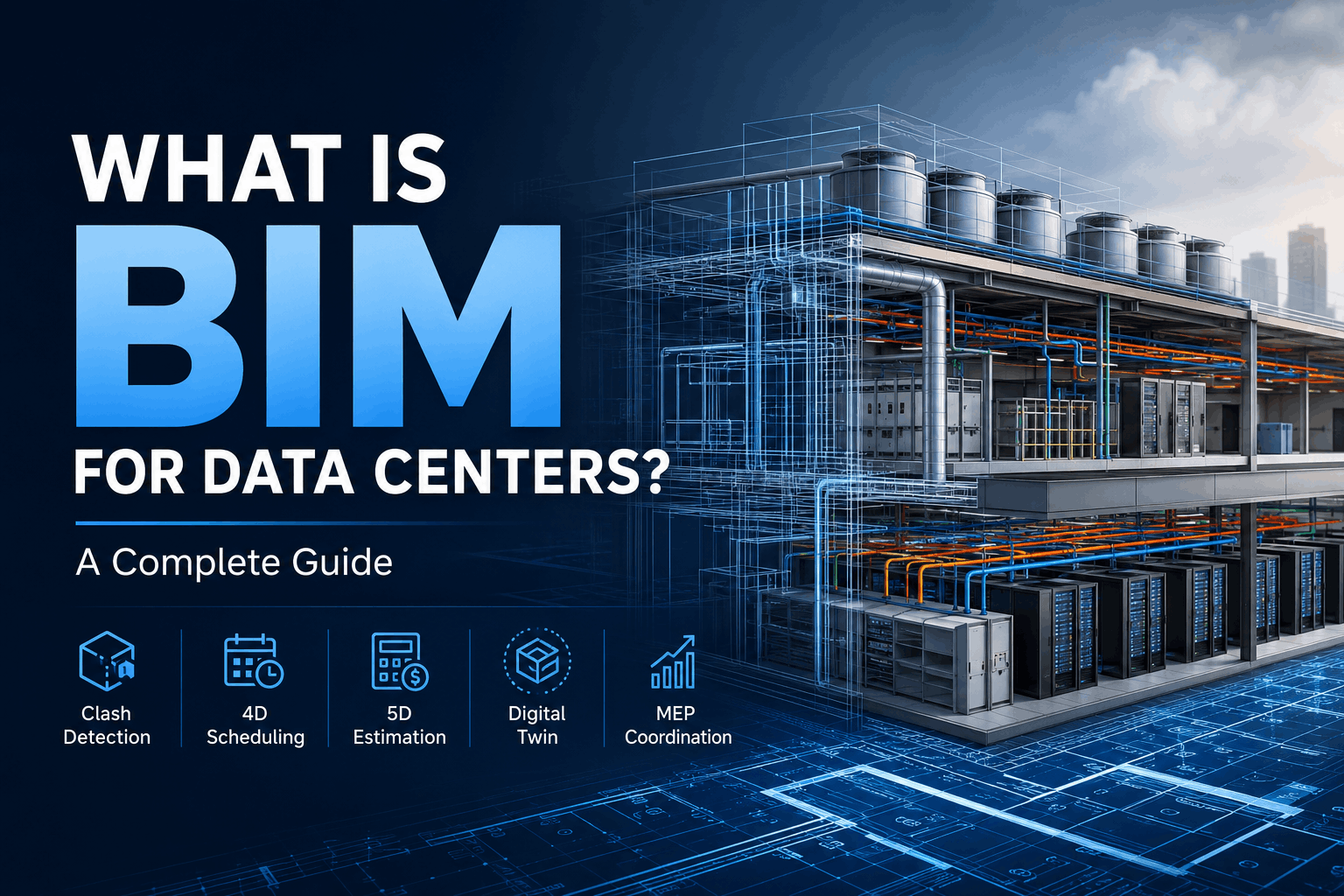
The relentless surge in cloud computing, artificial intelligence (AI) workloads, 5G deployments, and global digital transformation has turned data centers into the lifeblood of modern society. However, constructing these facilities is incredibly challenging. Data centers are not typical commercial real estate; they are highly complex, energy-intensive, mission-critical infrastructures where every square inch demands millimetric precision. In this high-stakes environment, traditional 2D drafting methods fall short, often leading to costly material waste, schedule delays, and catastrophic operational downtime.
To build tomorrow’s infrastructure efficiently, the Architecture, Engineering, and Construction (AEC) industry has turned to a revolutionary digital process: Building Information Modeling. But what exactly is BIM for Data Centers, and how does it redefine the lifecycle of these facility assets?
This comprehensive guide explores how specialized Data Center BIM Services optimize spatial layout, streamline complex mechanical, electrical, and plumbing (MEP) systems, and establish a framework for long-term facility operational excellence.
Understanding BIM for Data Centers
At its core, BIM for Data Centers is an intelligent, 3D model-based process that gives AEC professionals the insight and digital tools to plan, design, construct, and manage mission-critical infrastructure more efficiently. Rather than simply generating static drawings, Building Information Modeling creates a data-rich, centralized virtual replica of the facility. This model houses structural parameters alongside functional specifications, such as server rack dimensions, power thresholds, and cooling airflow dynamics.
Data centers demand unprecedented density across multiple engineering disciplines. Within a restricted space, thousands of high-capacity electrical cable trays, massive HVAC ductworks for liquid and air cooling, redundant backup power lines, and automated fire suppression systems must run concurrently without intersecting.
By executing projects through a centralized digital workspace, project owners, EPC contractors, and MEP engineers can collaborate simultaneously. This collaborative approach eliminates communication silos and ensures that design changes propagate in real time across all documentation.
Why Mission-Critical Infrastructure Requires Data Center BIM Services
Standard commercial construction projects often allow for minor geometric adjustments on the field. In contrast, data center construction has zero tolerance for error. A single design oversight that causes an electrical line to block a cooling path can delay commissioning by weeks, accumulating millions of dollars in idle overhead.
Deploying specialized Data Center BIM Services addresses these engineering challenges at the foundational level:
- Extreme MEP Density: High-performance computing clusters generate immense heat, requiring dense, complex cooling pipelines and redundant electrical infrastructure. BIM coordinates these systems down to the millimeter.
- Aggressive Speed-to-Market: The digital economy demands rapid capacity expansion. Hyper-scale providers cannot afford multi-year development cycles. BIM accelerates workflows, enabling concurrent engineering and rapid field assembly.
- Strict Redundancy Protocols: Tier III and Tier IV data centers require concurrent maintainability and fault tolerance ($N+1$ or $2N$ redundancy architectures). Digital models make it simple to track, map, and validate these backup systems visually before breaking ground.
Key Benefits of BIM for Data Centers
Implementing Building Information Modeling throughout the project lifecycle yields measurable performance advantages. Let us analyze the primary structural benefits that top-tier developers realize when integrating BIM workflows.
1. Advanced Clash Detection and Risk Mitigation
The most immediate financial return from BIM comes through automated automated clash detection. Utilizing advanced software platforms like Autodesk Revit and Navisworks, engineering teams can run automated audits to discover internal spatial conflicts before construction materials are ordered.
For instance, BIM instantly flags situations where an overhead structural beam clips a heavy-duty cooling duct, or where a fire sprinkler route compromises a high-voltage electrical cable tray. Resolving these spatial discrepancies virtually reduces field rework by up to 95%, safeguarding both the project budget and the timeline.
2. Streamlining High-Precision MEP Coordination
Mechanical, Electrical, and Plumbing (MEP) systems constitute the highest percentage of total capital expenditure in data center construction. Managing these interconnected networks requires precise cross-disciplinary alignment.
| System Category | Crucial BIM Coordination Points | Impact on Performance |
| Mechanical / HVAC | Hot/cold aisle containment, liquid cooling loops, air handling placement | Minimizes hotspots; optimizes Power Usage Effectiveness (PUE) |
| Electrical Infrastructure | Switchgear allocation, UPS systems, dense cable tray routing | Ensures clean power distribution for high-density GPU clusters |
| Plumbing & Fire Safety | Pre-action dry pipe layout, drainage, leak detection systems | Eliminates water hazard risks around sensitive server components |
3. Enabling Off-Site Modular Prefabrication
Speed and consistency are vital elements for data centers; as a result, modular construction has become a preferred approach in recent times. By developing accurate, fabrication-ready models at a high Level of Development (LOD 400), BIM allows manufacturers to pre-assemble complex components off-site in controlled factory conditions.
Multi-tier MEP skids, modular power rooms, pre-terminated cable connections, and pre-assembled server racks can be fabricated miles away from the job site and delivered exactly when needed. This plug-and-play field assembly accelerates installation times by 20% to 30% while reducing on-site labor congestion and material waste.
4. 4D Scheduling and 5D Cost Estimation
Beyond visual 3D design, modern BIM adds crucial dimensions to project controls. By linking the digital model to construction timelines (4D BIM), managers can simulate installation sequences visually. This helps identify logistical bottlenecks on site before they manifest physically.
Furthermore, integrating cost data into the components (5D BIM) generates instantaneous, highly accurate Bills of Materials (BOM). This automated procurement tracking minimizes material waste and prevents unexpected budget overruns.
From Construction to Operation: The Power of the Digital Twin
The utility of a data center BIM model does not terminate upon building handover. In fact, some of its most profound financial benefits are realized over the facility’s operational life.
By updating the model with field variations during assembly, contractors produce a precise as-built digital archive. When integrated with real-time Internet of Things (IoT) sensors, building management systems (BMS), and power monitoring tools, this asset transforms into an operational Digital Twin.
[Image illustrating a Digital Twin workflow connecting physical server rack IoT sensors to a live 3D BIM model]
Data center facility management teams can leverage this interconnected digital environment to monitor live performance parameters, including:
- Server rack heat signatures and ambient temperature differentials.
- Real-time power consumption metrics across specific server arrays.
- Predictive maintenance alerts that flag component wear before a failure causes downtime.
Should an emergency occur—such as a critical cooling pump failure or localized electrical overload—facility managers can review the exact 3D spatial layout on their screens instantly. This visibility ensures technicians find isolation valves and backup switches in seconds, reducing response times and preserving critical system uptime.
How Acura BIM Delivers Precision for Mission-Critical Environments
Designing and managing data center infrastructure demands specialized technical expertise, custom-tailored workflows, and deep familiarity with international building standards. As an industry-vetted leader in the AEC engineering space, Acura BIM provides precision-engineered, high-performance BIM solutions optimized specifically for data center architecture.
Whether managing a 15-acre hyperscale deployment or configuring a compact edge computing site, our specialized team manages full-lifecycle digital delivery. We align closely with developers, general contractors, and MEP firms to convert complex conceptual designs into fully clash-free, construction-ready packages.
Our Specialized Engineering Capabilities Include:
- End-to-End BIM Modeling (LOD 100 to LOD 500): Developing comprehensive, data-rich architectural, structural, and hyper-detailed MEP models.
- Rigorous Clash Resolution: Executing detailed multi-disciplinary coordination in Navisworks to completely eliminate field errors prior to site mobilization.
- Scan-to-BIM Deliverables: Utilizing terrestrial laser scanning data to generate highly accurate digital models of existing infrastructure for expansions or brownfield retrofits.
- Prefabrication and Spool Modeling: Authoring high-fidelity models that feed directly into off-site manufacturing pipelines for modular components.
At Acura BIM, we combine advanced software suites—including Autodesk Revit, Navisworks, and BIM 360/Autodesk Construction Cloud—with disciplined quality assurance workflows. This rigorous approach ensures every drawing is verified for accuracy and compliance before it reaches the field.
Explore our comprehensive service portfolio and technical capabilities directly at Acura BIM Modeling Services.
Driving Sustainability and AI Integration in Infrastructure
As energy efficiency regulations tighten globally, minimizing environmental impact has become a top priority for data center operators. Modern facilities are intensive consumers of electrical and water resources, meaning even a fractional improvement in operational efficiency yields substantial financial and environmental savings.
Integrating advanced computational tools with Building Information Modeling allows design teams to run comprehensive energy simulations early in the pre-design phase. Engineers can model airflow profiles utilizing Computational Fluid Dynamics (CFD) packages integrated directly with BIM layouts. This testing helps developers optimize air containment boundaries, position cooling units precisely, and refine HVAC duct designs to lower the facility’s overall Power Usage Effectiveness (PUE).
Furthermore, the introduction of Artificial Intelligence (AI) into BIM pipelines is accelerating design generation. Generative design algorithms can automatically evaluate thousands of structural and mechanical layouts within the BIM framework. These systems recommend optimal configurations for server rack layouts, cable tray paths, and structural support systems based on predefined parameters like cooling efficiency, structural load limitations, and budget constraints. This AI-driven automation empowers engineering teams to make smarter decisions faster, building future-ready data centers that balance performance with strict sustainability metrics.
Maximizing ROI: The Long-Term Financial Impact of BIM
While some project owners view the initial investment in comprehensive BIM modeling as an additional upfront expense, historical project metrics demonstrate that the long-term return on investment (ROI) is substantial. The financial advantages compound across every phase of the asset lifecycle:
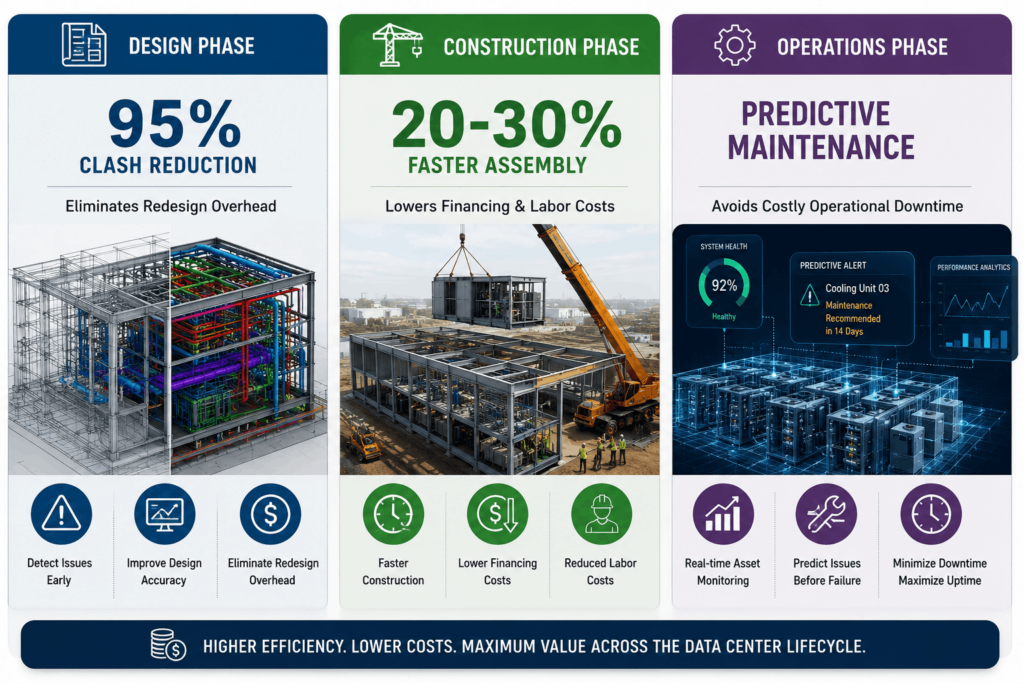
By investing in precision coordination before breaking ground, developers prevent the compounding expenses that stem from field modifications, idled installation crews, and material procurement errors. In a competitive market where speed-to-market dictating business viability, BIM serves as a strategic framework that ensures projects are completed on schedule, within budget, and built to scale.
Choosing the Right BIM Partner for Your Next Facility
Data center development leaves no room for trial and error. The structural density and operational requirements of these facilities demand an engineering partner who understands the nuances of mission-critical environments. Working with generalist design firms often introduces risks, as they may lack familiarity with the tight tolerances and redundancy requirements of Tier-rated facilities.
When selecting an external BIM engineering partner, evaluate their technical capabilities against these essential operational criteria:
- Proven Scale and Expertise: Can the team manage high-volume, multi-disciplinary modeling across complex mechanical and electrical networks?
- Advanced Tool Mastery: Do they utilize modern cloud collaboration platforms (like BIM 360 or ACC) to facilitate transparent, real-time coordination with international project teams?
- Commitment to Quality: Does the firm enforce multi-tiered quality assurance protocols to ensure drawings are ready for field execution without further revision?
Acura BIM meets these criteria, supporting complex digital infrastructure projects with precision, speed, and technical excellence. Our experienced team addresses engineering challenges early in the virtual environment, providing clarity and predictability for every stakeholder.
Are you preparing to design, scale, or retrofit your critical digital infrastructure? Partner with the engineering experts at Acura BIM to ensure your project is executed with precision, speed, and total clarity.
Contact our engineering team today at david@acurabim.com or submit your project requirements online via our contact portal to receive a specialized project evaluation and custom quote: Contact Acura BIM Experts.
Frequently Asked Questions (FAQ)
What is the primary difference between traditional BIM and specialized BIM for data centers?
While standard BIM focuses on general spatial configuration and aesthetics for commercial spaces, BIM for data centers prioritizes high-density MEP coordination, strict compliance with Tier redundancy guidelines, cooling efficiency, and operational uptime management.
How does BIM assist in reducing a data center’s Power Usage Effectiveness (PUE)?
BIM allows design teams to perform early-stage airflow and thermodynamic simulations by exporting data-rich geometries into Computational Fluid Dynamics (CFD) software. This optimization prevents hot/cold air mixing, improves cooling containment design, and reduces overall energy consumption.
At what stage of development should Data Center BIM Services be introduced?
BIM services provide the highest value when introduced during the pre-design and conceptual phases. Early implementation allows for seamless architectural and structural planning, establishing a clash-free foundation before heavy mechanical and electrical designs are developed.
What is a Digital Twin, and how does it relate to data center operations?
A Digital Twin is a live, data-integrated virtual model of an as-built data center. By linking the structural BIM model with real-time IoT sensors and facility management platforms, operators can monitor power distribution, temperature gradients, and equipment lifecycles continuously.
How does BIM support modular prefabrication for data centers?
BIM delivers highly detailed 3D models at an advanced Level of Development (LOD 400). These models provide the precise dimensional data required by off-site manufacturers to pre-assemble MEP skids, power modules, and server racks, ensuring they fit seamlessly when delivered to the construction site.
Which software platforms are standard within data center BIM workflows?
Top-tier engineering firms rely on industry-standard platforms, including Autodesk Revit for data-rich modeling, Navisworks for automated clash detection and coordination review, and Autodesk Construction Cloud (BIM 360) to maintain real-time cloud collaboration among distributed stakeholders.
