
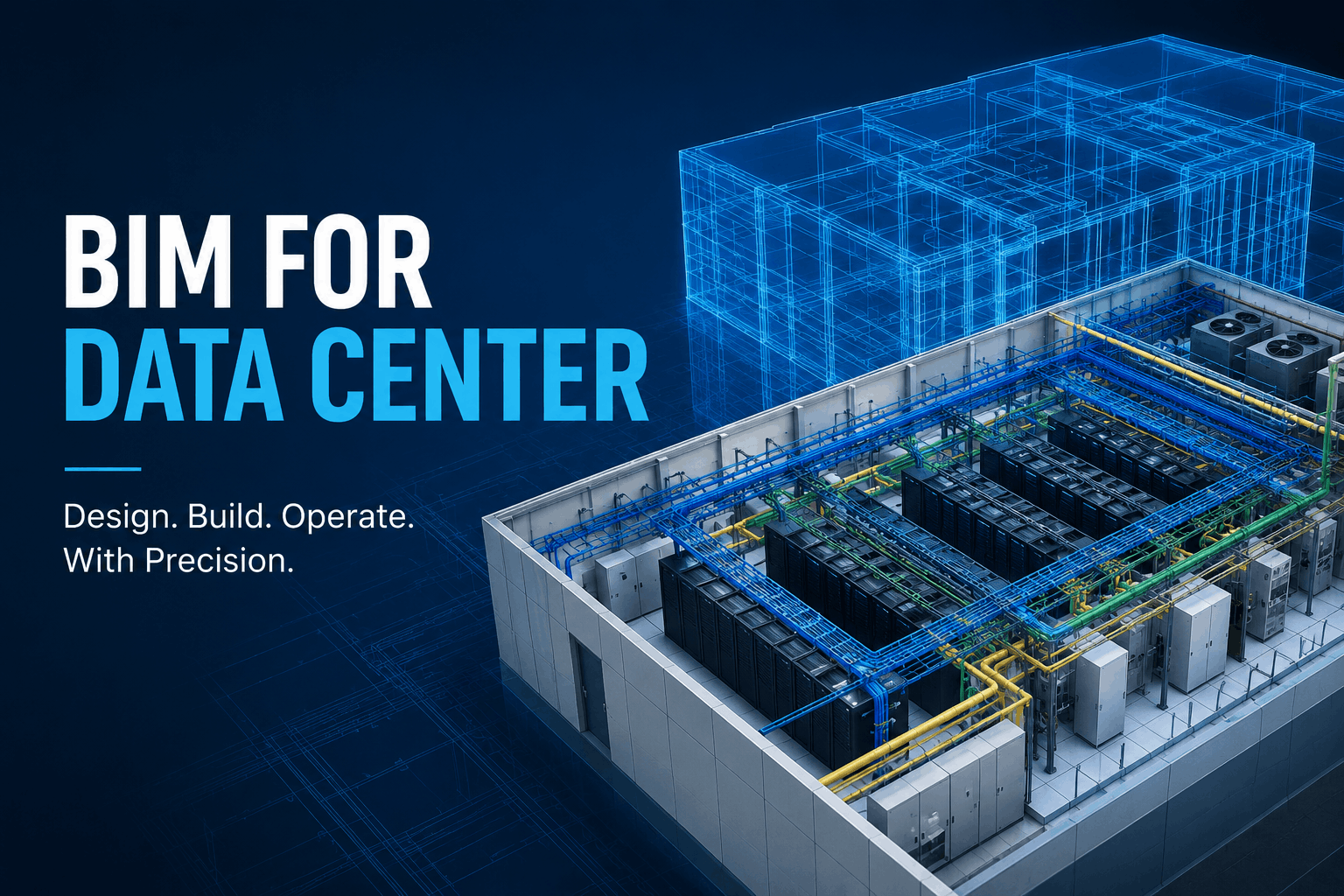
The global demand for digital infrastructure is expanding at an astronomical rate. Driven by high-density artificial intelligence (AI) workloads, cloud computing deployments, and continuous 5G expansions, data centers have evolved into highly complex, power-dense, and hyperscale environments. Because these facilities operate under stringent 99.999% uptime mandates, traditional architectural planning and siloed construction methods are no longer sufficient. Consequently, forward-thinking engineering teams are turning to BIM for Data Center projects to orchestrate flawless execution from initial sketches to daily facility maintenance.
Building Information Modeling (BIM) serves as a unified digital ecosystem that bridges the gaps between architecture, structural engineering, and dense mechanical systems. By adopting BIM for Data Center Design, Construction & Facility Management, project stakeholders can successfully de-risk complex installations, minimize material waste, and guarantee a seamless asset handover. This comprehensive guide details how cutting-edge digital engineering mitigates risk across every phase of the mission-critical facility lifecycle.
1. The Multi-Disciplinary Challenge of Modern Data Center Infrastructure
Data centers are inherently different from standard commercial real estate developments. They are industrial machines housed within an architectural shell, requiring immense power distribution networks, intensive mechanical cooling layouts, and highly secure structured cabling frameworks.
Managing these dense utility networks inside limited structural spaces creates massive engineering bottlenecks. When architectural elements, structural supports, and heavy industrial machinery are designed in isolation, physical spatial conflicts inevitably surface on-site. Traditional 2D drawings frequently fail to capture these intricate spatial dynamics, leading to catastrophic field conflicts, expensive change orders, and crippling project delays.
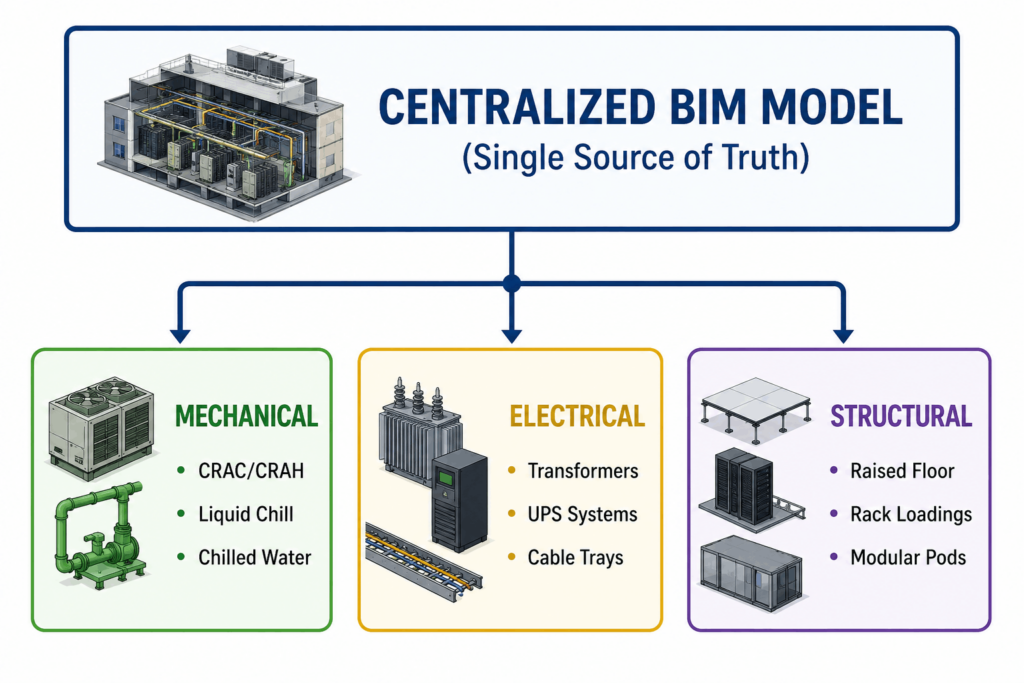
Furthermore, data center developers must build with rapid speed-to-market and future flexibility in mind. To reconcile hyper-accelerated timelines with zero-error construction requirements, implementing specialized data center engineering solutions is paramount. This is where a centralized 3D digital model acts as the single source of truth, aligning all design, contracting, and operational stakeholders long before a single shovel touches the dirt.
2. Phase 1: Precision Engineering Through Data Center Design BIM
The journey toward an efficient, high-performance facility begins in the virtual planning environment. Integrating sophisticated Data Center Design BIM methodologies allows engineering teams to construct a data-rich, parametric model that reflects exact physical and operational parameters.
Hot/Cold Aisle Containment and Computational Fluid Dynamics (CFD)
Modern server racks generate immense heat loads that demand precise structural separation between hot exhaust air and cold supply air. By leveraging advanced architectural and mechanical models, designers can simulate precise structural layouts for hot/cold aisle containment structures. These parametric models can be directly integrated into Computational Fluid Dynamics (CFD) software. This integration allows engineers to analyze airflow velocities, predict localized thermal hot spots, and fine-tune cooling configurations prior to procurement.
Intelligent Asset Data Integration
Every component populated within a data-rich design model—whether a massive backup generator, an uninterruptible power supply (UPS) system, or an isolated power distribution unit (PDU)—carries precise metadata. This embedded information includes exact electrical tolerances, manufacturer specifications, weight allocations, and spatial boundary clearances. Consequently, the design team can balance total power distribution and floor weight thresholds dynamically as the spatial design evolves.
3. Phase 2: Resolving System Overlaps via BIM Coordination Data Centers
The modern server hall ceiling and underfloor voids are incredibly crowded spaces. Chilled water pipes, heavy electrical conduits, large-diameter ductwork, and hundreds of optical fiber trays must all navigate the exact same pathways. Without rigorous spatial control, site crews will consistently run into physical structural blockages during field installation.
Executing disciplined BIM Coordination Data Centers protocols effectively solves this problem. Utilizing advanced visualization and analytical applications like Autodesk Navisworks, multidisciplinary models are aggregated into a single platform to execute comprehensive automated clash analysis.
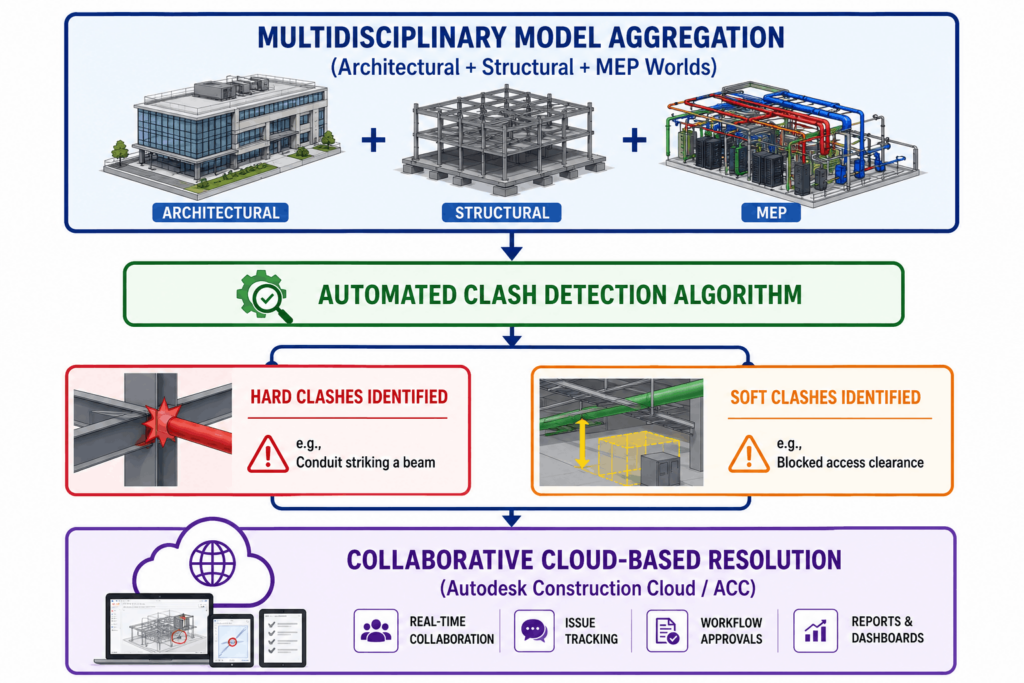
- Hard Clashes: These represent direct physical intersections between distinct building components. For instance, an automated clash detection sweep will instantly flag a large mechanical duct slicing directly through a primary structural steel beam or an electrical cable tray.
- Soft Clashes: These track spatial clearance conflicts and operational maintenance violations. A soft clash occurs if a chilled water line is modeled too close to an electrical switchgear enclosure, violating safety clearance codes, or if a valve is positioned where a technician cannot safely reach it.
By transitioning from reactive problem-solving on the construction floor to proactive design resolution in the cloud, engineering teams routinely eliminate up to 95% of spatial design errors before site mobilization begins. This drastically minimizes field rework and keeps aggressive project timelines firmly on schedule.
4. Phase 3: Mitigating Congestion with Advanced MEP BIM for Data Centers
Mechanical, Electrical, and Plumbing (MEP) infrastructure represents the true operational core of any mission-critical facility. Given that MEP systems account for the majority of data center capital expenditure, maximizing installation efficiency within these disciplines is vital.
Deploying specialized MEP BIM for Data Centers allows engineers to map out hyper-dense electrical and mechanical pathways to millimeter precision. Because power distribution lines and cooling paths require structural redundancy (such as N+1 or 2N architectures), the sheer volume of equipment doubles or triples. Navigating this immense volume of infrastructure requires dedicated, high-tier modeling techniques.
Moreover, precision-engineered MEP modeling provides the necessary foundation for off-site prefabrication and modular construction. Rather than measuring, cutting, and welding complex piping manifolds or heavy electrical rack assemblies on a congested job site, contractors can export highly accurate spool drawings directly from the coordinated model.
These components are manufactured under tightly controlled factory conditions, shipped directly to the site, and rolled into place for rapid “plug-and-play” assembly. This parallel workflow significantly reduces on-site labor requirements, minimizes material scrap, and shortens the overall construction schedule.
5. Phase 4: Streamlining On-Site Execution with Data Center Construction Management
During the active building phase, a high-quality model transitions from a strict design reference into an indispensable tool for active Data Center Construction Management. As construction managers coordinate multiple specialized trade sub-contractors on-site, the central digital model ensures everyone executes from the exact same layout.
By integrating the element of time into the 3D model, construction leads unlock powerful 4D BIM simulations. Project schedules are mapped directly to corresponding structural and mechanical objects within the model. This allows superintendents to visually simulate the entire construction sequence, identifying potential logistical bottlenecks and scheduling conflicts before they occur.
For instance, 4D staging simulations allow managers to carefully plan the exact arrival, crane lift path, and structural placement of heavy, long-lead equipment items—such as multi-ton chillers or modular generators. This level of logistical foresight eliminates unnecessary crane downtime, prevents trade worker overcrowding, and ensures site safety remains uncompromised.
6. Phase 5: The Digital Twin Data Center for Smarter Facility Operations
The utility of Building Information Modeling does not end once the construction crews pack up and the keys are handed over. In fact, a data center’s operational phase spans decades and incurs far greater costs than initial design and construction. This reality makes a seamless data transition from construction to operations essential.
During the building commissioning process, the physical layout is cross-referenced with the digital model. Any minor field adaptations are updated to deliver an ultra-precise, as-built model rich with historical asset documentation. This comprehensive asset dataset can be fed directly into Computerized Maintenance Management Systems (CMMS) and Integrated Workplace Management Systems (IWMS) via standardized COBie (Construction Operations Building Information Exchange) data structures.
Ultimately, this rich asset data serves as the foundation for a fully realized Digital Twin Data Center. By linking the static, data-rich physical asset model with real-time operational streams from Internet of Things (IoT) sensors, building automation networks, and Supervisory Control and Data Acquisition (SCADA) systems, facility managers gain unprecedented visibility into operations:
- Predictive Maintenance Diagnostics: Instead of relying on rigid, calendar-based maintenance schedules, facility leads track actual equipment performance trends. If a critical condenser pump shows abnormal vibration patterns or elevated power draws, the system automatically alerts technicians to intervene before a catastrophic failure occurs.
- Real-Time PUE Optimization: Power Usage Effectiveness (PUE) is the gold standard metric for data center energy efficiency. A live digital twin allows engineering teams to continuously monitor thermal gradients across individual server racks, dynamically adjusting mechanical cooling outputs to minimize unnecessary energy consumption.
- Immersive Disaster Simulations: Emergency response teams utilize the digital twin to run virtual failure scenarios, such as localized electrical faults or cooling line breaks. Because the system maps every interconnecting valve, bypass switch, and redundancy line in immersive 3D, operators can practice rapid isolation procedures to maximize continuous uptime.
7. Maximizing Digital Efficiency with Data Center BIM Services
Building, maintaining, and managing a mission-critical infrastructure asset requires a deep commitment to digital accuracy. To help developers navigate this complex landscape, partnering with an experienced global BIM provider is an absolute necessity.
Comprehensive Service Offerings
Professional Data Center BIM Services deliver specialized end-to-end support across every stage of the project lifecycle. These professional teams provide high-fidelity 3D structural and architectural modeling (from LOD 100 up to fabrication-ready LOD 500 models), comprehensive automated clash detection sweeps, and intelligent point-cloud to BIM conversions for complex facility expansions.
Advanced Technology and Industry Standards
Top-tier digital engineering firms leverage industry-standard platforms—including Autodesk Revit, Navisworks, and the Autodesk Construction Cloud (ACC)—to guarantee seamless, cloud-based data collaboration among global engineering stakeholders. Furthermore, their workflows strictly align with international information management frameworks like ISO 19650 Standards, ensuring data consistency, governance, and traceability across global boundaries.
8. Case Study: BIM Excellence in a 15+ Acre Hyperscale Infrastructure Project
To truly understand the tangible impact of integrated digital engineering, one can look to real-world industrial executions. A prime example is the recent large-scale infrastructure deployment managed by Acurabim Engineers for a major hyperscale data center facility in India.
The Project Challenge
Acurabim Engineers was selected to deliver comprehensive architectural, structural, and complete MEP coordination modeling for a massive, 15+ acre hyperscale data center facility developed by the Adani Group for Microsoft. Given the scale of the facility, the design required navigating extreme utility density, massive electrical cable tray routing challenges, and incredibly complex cooling infrastructures—all under an aggressive, fast-track delivery schedule.
The Engineering Solution
Leveraging the power of the Autodesk Construction Cloud (ACC) alongside Revit and Navisworks, Acurabim’s specialized engineering team created an integrated, multi-disciplinary coordination environment. The team ran parallel modeling workflows that allowed real-time design updates and proactive change management.
The Measurable Outcomes
- Flawless Spatial Coordination: The team successfully mapped out and resolved dense mechanical cooling configurations and complex hot/cold aisle containments prior to site mobilization.
- Zero Field Rework: By identifying and resolving thousands of potential hard and soft clashes virtually, the project team achieved zero structural rework during the MEP installation phase.
- Rapid Speed-to-Market: The use of fabrication-ready models allowed for extensive off-site prefabrication, ensuring the fast-track infrastructure schedule was met with complete precision.
9. Driving Modern Infrastructure Success with Acurabim Engineers
Successfully delivering a modern, high-performance data center requires an uncompromising commitment to precision, deep domain-specific knowledge, and robust technological workflows. As an established global leader in virtual design and construction, Acurabim Engineers stands out as the premier digital engineering partner for hyperscale, enterprise, co-location, and modular data center developments worldwide.
Our specialized, mission-critical engineering division deeply understands the nuanced complexities of high-density cooling architectures, redundant power systems, and intense MEP distribution pathways. By combining decades of practical AEC industry experience with automated BIM workflows, we help developers, EPC contractors, and facility operators minimize project risks, compress construction schedules, and significantly lower overall capital expenditures.
Whether you are breaking ground on an ambitious new hyperscale campus, planning a complex brownfield facility expansion via scan-to-BIM, or looking to build an operational digital twin for asset management, our engineering team is equipped to deliver world-class accuracy. Explore our comprehensive suite of services and view our proven portfolio of successful global projects directly at Acura BIM Services.
10. Partner with the World’s Leading Data Center BIM Specialists
Do not let uncoordinated 2D design drawings, unforeseen field clashes, or expensive change orders derail your next mission-critical infrastructure project. Achieve flawless coordination, rapid speed-to-market, and lifelong asset operational efficiency by partnering with the digital construction specialists at Acurabim Engineers.
Our dedicated engineering teams are ready to support your project requirements from initial concept planning up to operational handover. Let us help you transform complex data center challenges into smooth, predictable, and highly efficient construction outcomes.
Contact our engineering team today to request a comprehensive technical consultation or a custom project quote: AcuraBim
Frequently Asked Questions (FAQ)
1.What are the main benefits of using BIM for data center design and construction?
Implementing BIM provides a centralized 3D digital environment that drastically improves multidisciplinary collaboration. The core benefits include an automated 95% reduction in design clashes, an 8% to 12% lowering of overall project construction costs, a 20% to 30% compression of installation timelines, and the complete elimination of expensive site rework.
2.How does BIM assist in the coordination of dense data center MEP systems?
Data center MEP systems are incredibly dense and require strict redundancy. Automated clash detection platforms like Navisworks scan the integrated model to flag physical intersections (hard clashes) and maintenance clearance violations (soft clashes) between mechanical cooling lines, structural beams, and electrical cable trays before site fabrication begins.
3.What role does a digital twin play in data center facility management?
A digital twin maps the precise physical, as-built geometry of the data center and links it with real-time operational data from IoT sensors and building automation networks. This allows facility managers to execute predictive maintenance diagnostics, optimize cooling configurations to lower Power Usage Effectiveness (PUE), and run virtual emergency disaster simulations.
4.Can BIM modeling support modular data center prefabrication?
Yes. BIM models provide fabrication-ready detail levels (LOD 400/500). Contractors can extract highly accurate spool drawings directly from the coordinated model, allowing complex MEP piping manifolds and electrical rack assemblies to be prefabricated off-site under factory-controlled conditions for rapid plug-and-play assembly on-site.
5.Why should we partner with Acurabim Engineers for our next data center project?
Acurabim Engineers is a globally trusted BIM specialist with a proven track record of supporting large-scale, mission-critical infrastructure projects—including massive hyperscale facilities for Adani and Microsoft. We provide 100% coordinated, IFC-ready construction drawings, specialized MEP cooling expertise, and data deliverables that strictly adhere to international standards like ISO 19650.
